


Executive Summary
Commercial priorities across the polyurethane industry are gradually shifting from maximizing production volumes toward delivering higher-value material solutions for increasingly specialized applications. Mature end-use industries continue providing the foundation of global demand, while procurement decisions are becoming more performance-oriented as manufacturers seek materials that improve product durability, energy efficiency, processing productivity and lifecycle economics. Polyurethane has consequently evolved into a highly application-driven market where formulation capability, technical support and customer-specific solutions increasingly influence commercial competitiveness alongside manufacturing scale.
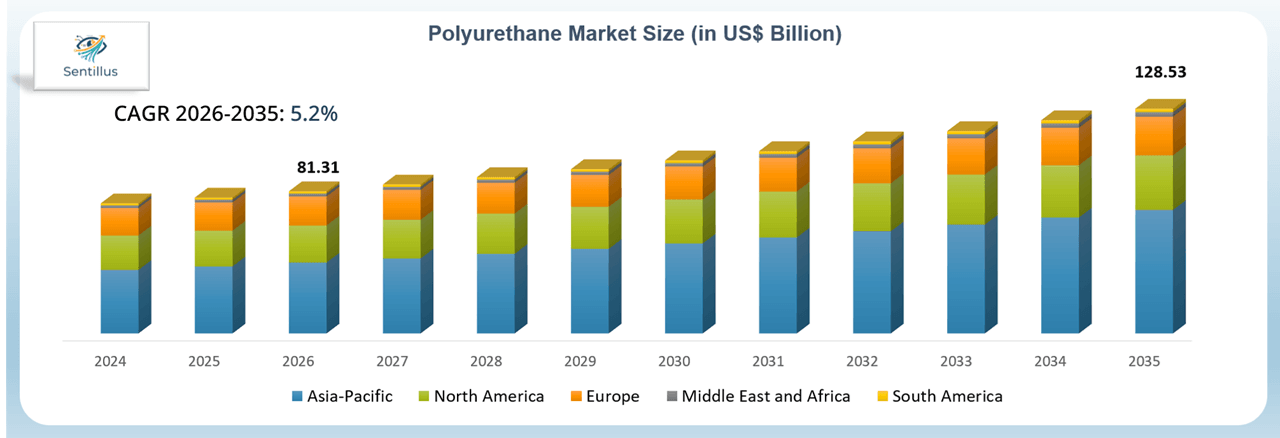
The global polyurethane market is valued at USD 81.31 billion in 2026 and is projected to reach USD 128.53 billion by 2035, registering a compound annual growth rate (CAGR) of 5.2%. Consumption volume is estimated at 26.78 million tons in 2026 and is forecast to increase to 41.64 million tons by 2035, representing a 5.0% CAGR. Value growth slightly exceeds volume expansion, indicating that product mix enhancement and higher-value polyurethane solutions are contributing more to market expansion than pricing alone. Polyurethane demand remains balanced across multiple downstream industries, limiting dependence on a single application and providing resilience against cyclical fluctuations in individual end-use markets.
A highly integrated value chain continues to support stable market development, beginning with isocyanates and polyols before extending to formulated systems and finished polyurethane products. Vertical integration across raw material production and downstream processing strengthens supply reliability while improving operational flexibility during periods of feedstock price volatility. Large multinational manufacturers maintain geographically diversified production networks that reduce supply-chain risk and ensure consistent material availability for construction, transportation, industrial manufacturing, consumer products, electronics, healthcare and other high-volume industries.
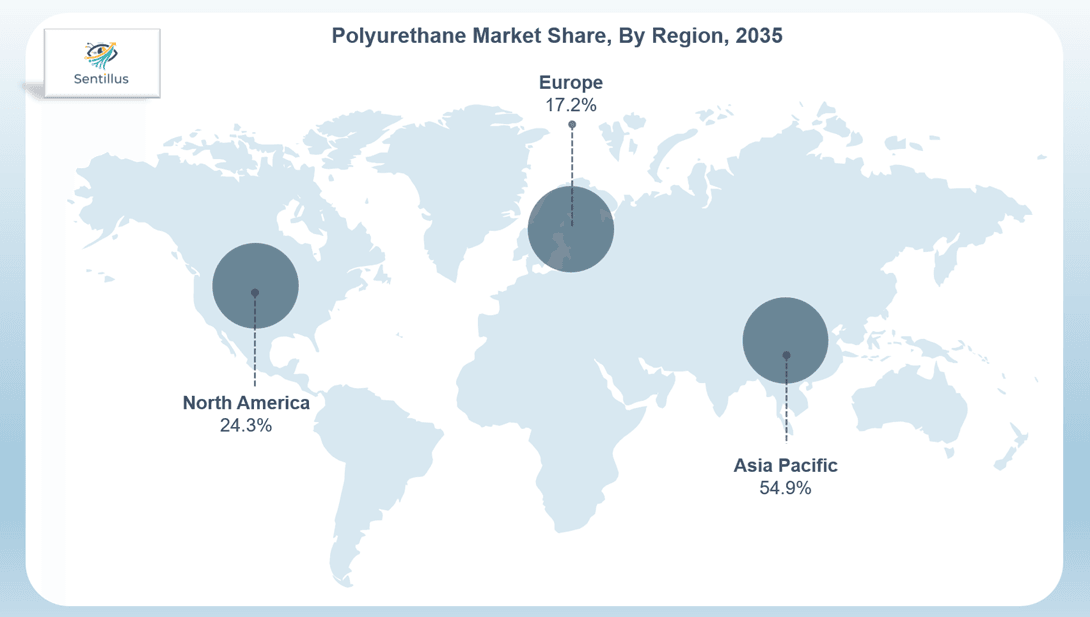
Asia-Pacific remains the largest regional market and also records the fastest long-term expansion, supported by integrated chemical manufacturing, broad industrial production and sustained downstream demand. China continues to lead global polyurethane consumption while maintaining the fastest growth among major markets, reflecting its extensive manufacturing ecosystem and strong domestic demand. North America and Europe remain strategically important through advanced manufacturing capabilities, established customer industries and high-value polyurethane applications where technical performance and product quality influence purchasing decisions more than production volume.
Regional market distribution continues to demonstrate the global diversification of polyurethane demand. North America accounts for USD 21.23 billion in 2026 and is projected to reach USD 31.26 billion by 2035, while Europe expands from USD 16.63 billion to USD 22.14 billion during the same period. Among major country markets, United States generates USD 15.56 billion in 2026, followed by China at USD 22.51 billion, India at USD 7.11 billion, Germany at USD 5.40 billion, Japan at USD 4.75 billion, Italy at USD 3.72 billion, Canada at USD 3.53 billion, Australia at USD 3.37 billion, United Kingdom at USD 3.32 billion, Mexico at USD 2.14 billion and France at USD 1.99 billion. Industrial expansion, infrastructure investment, consumer manufacturing and replacement demand collectively sustain polyurethane consumption across these markets despite differences in economic maturity and application mix.
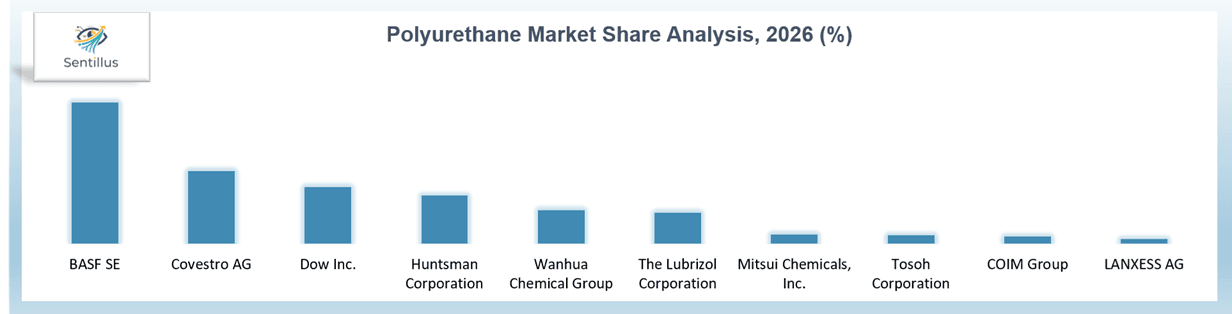
Industry competition increasingly favors manufacturers capable of combining secure raw material sourcing with advanced formulation expertise and efficient customer support. Commercial success is progressively determined by the ability to develop application-oriented polyurethane systems that address evolving performance requirements across diverse manufacturing industries. Such market dynamics continue encouraging investment in specialized product development, allowing polyurethane suppliers to strengthen long-term customer relationships while expanding opportunities in higher-value industrial applications.
Market Dynamics
Driver: Expansion of High-Performance Building Insulation Supports Polyurethane Consumption
Increasingly stringent building energy-efficiency regulations and investment in cold-chain infrastructure continue strengthening demand for polyurethane insulation materials. Rigid polyurethane foam and spray polyurethane foam remain preferred solutions because they deliver high thermal efficiency with relatively thin insulation profiles. Rising adoption across commercial buildings, refrigerated warehouses, food processing facilities and pharmaceutical cold storage is encouraging polyurethane manufacturers to expand insulation-focused product portfolios and application-specific formulations.
Opportunity: Commercialization of Circular and Bio-Based Polyurethane Creates Premium Value Opportunities
Circular feedstocks, bio-based polyols and recycled polyurethane technologies are moving from pilot projects toward commercial production as manufacturers respond to customer decarbonization targets and regulatory requirements. ISCC PLUS-certified raw materials, biomass-balanced formulations and chemical recycling technologies allow suppliers to differentiate premium product portfolios while supporting procurement strategies focused on lower product carbon footprints without compromising material performance.
Segment Analysis
By Product: Foam Products Continue to Lead Polyurethane Demand Through Diverse Industrial Applications
Foam products account for the largest share of polyurethane consumption, generating USD 56.75 billion in 2026 and projected to reach USD 93.49 billion by 2035 at a 5.7% CAGR. Commercial demand is distributed across furniture, bedding, construction, refrigeration, automotive interiors and packaging, reducing dependence on any single downstream industry. Flexible foam remains the largest foam category because recurring replacement demand from mattresses, upholstered furniture and vehicle seating creates stable consumption across both developed and emerging markets. Rigid foam continues supporting insulation-intensive applications where thermal efficiency, moisture resistance and dimensional stability influence material selection. Product innovation increasingly focuses on lower-emission formulations, recycled feedstocks and improved processing characteristics, enabling manufacturers to strengthen product differentiation without significantly altering established production technologies.
By Raw Material: Methylene Diphenyl Diisocyanate (MDI) Remains the Foundation of Polyurethane Manufacturing
Methylene diphenyl diisocyanate (MDI) represents the dominant raw material segment with a market value of USD 51.24 billion in 2026, forecast to increase to USD 83.29 billion by 2035 at a 5.5% CAGR. MDI supports the broadest range of polyurethane products, including rigid foams, flexible foams, spray polyurethane foam, elastomers, coatings, adhesives, sealants and formulated systems, making it the preferred feedstock for integrated manufacturers. Broad application compatibility improves manufacturing flexibility while allowing producers to optimize production across multiple end-use industries. Continued investment in MDI production capacity by global chemical manufacturers reflects its strategic importance within the polyurethane value chain and its ability to support both commodity and high-performance polyurethane applications.
By End-User: Bedding & Furniture Generates the Highest Polyurethane Consumption Through Continuous Replacement Demand
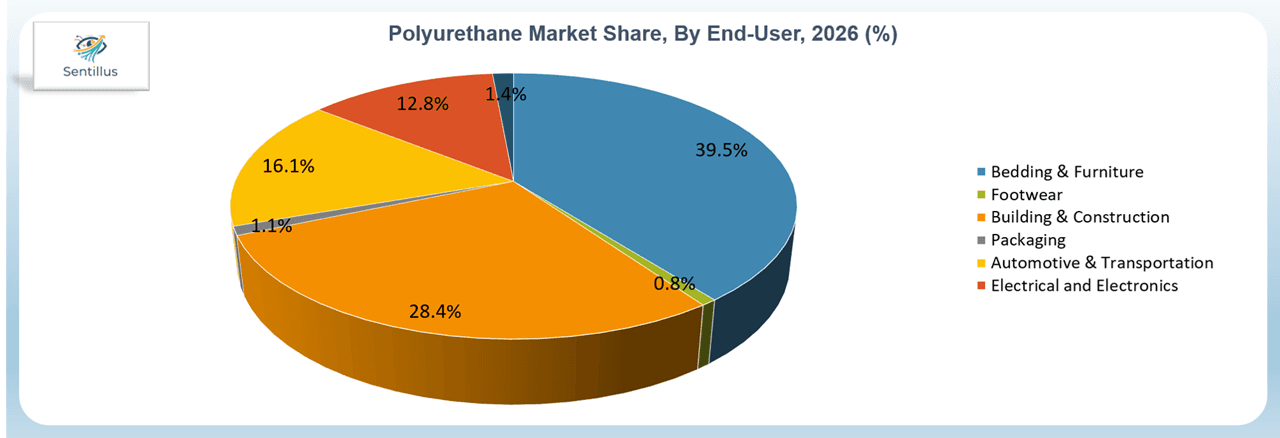
The bedding and furniture industry remains the largest end-user segment, accounting for USD 32.08 billion in 2026 and expected to reach USD 52.54 billion by 2035, expanding at a 5.6% CAGR. Mattress replacement cycles, residential furniture purchases, commercial office refurbishment, hospitality investments and rising consumer preference for premium comfort products collectively sustain long-term polyurethane consumption. Flexible polyurethane foam remains the material of choice because it combines comfort, resilience, durability and cost efficiency across a broad range of cushioning applications. Manufacturers continue introducing low-VOC, recycled-content and higher-performance foam formulations to address evolving consumer expectations while supporting furniture producers seeking improved product differentiation and sustainability credentials.
Regional Analysis
Asia-Pacific Leads Polyurethane Consumption Through Integrated Manufacturing and Broad Downstream Demand
Asia-Pacific represents the largest polyurethane market because the region combines upstream chemical production with extensive downstream manufacturing across construction, furniture, automotive, appliances, electronics, footwear and industrial equipment. Integrated supply chains enable regional producers to manufacture isocyanates, polyols, polyurethane systems and finished products within the same industrial ecosystem, improving cost competitiveness and supply reliability. Strong domestic demand is complemented by export-oriented manufacturing, allowing producers to operate at large commercial scale while continuously introducing higher-value polyurethane foam, thermoplastic polyurethane, polyurethane coating and polyurethane adhesive technologies.
China Polyurethane Market Analysis
China remains the world’s largest polyurethane market with a value of USD 22.51 billion in 2026, projected to reach USD 42.14 billion by 2035 at a 7.2% CAGR. Consumption volume expands from 7.57 million tons to 14.12 million tons during the forecast period. Demand extends across residential and commercial construction, refrigeration equipment, electric vehicles, consumer electronics, footwear, furniture, industrial machinery and packaging. China also hosts one of the world’s most comprehensive polyurethane manufacturing ecosystems, led by companies such as Wanhua Chemical Group, Covestro, BASF SE, Huntsman and numerous regional polyurethane system houses. Continued investment in specialty polyurethane materials, bio-based formulations and localized downstream production is strengthening the country’s position across both domestic consumption and export markets.
India Polyurethane Market Landscape
India represents the fastest-growing major polyurethane market after China, increasing from USD 7.11 billion in 2026 to USD 11.98 billion by 2035, supported by a 6.0% CAGR. Market volume rises from 2.30 million tons to 3.87 million tons over the same period. Construction, furniture manufacturing, refrigeration, automotive production, footwear and appliance manufacturing continue expanding polyurethane consumption, while government support for domestic manufacturing is encouraging greater localization of polyurethane systems and downstream processing. Growing investment by global manufacturers and regional system houses is also improving the availability of application-specific polyurethane materials for infrastructure, transportation, industrial equipment and consumer goods.
North America Benefits from High-Value Polyurethane Applications and Advanced Manufacturing
North America is valued at USD 21.23 billion in 2026 and is forecast to reach USD 31.26 billion by 2035, while market volume increases from 6.79 million tons to 9.51 million tons. Regional demand is supported by mature construction markets, automotive manufacturing, aerospace, industrial equipment, refrigeration and healthcare applications where performance requirements often favor premium polyurethane formulations over commodity materials.
United States Polyurethane Market Trends
The United States accounts for the largest share of regional demand with a market value of USD 15.56 billion in 2026, increasing to USD 23.42 billion by 2035. Consumption volume expands from 5.03 million tons to 7.14 million tons. Domestic demand is diversified across energy-efficient buildings, automotive manufacturing, aerospace components, medical devices, industrial machinery and advanced polyurethane foam products. The country also remains an important innovation center for thermoplastic polyurethane, polyurethane coating technologies, specialty elastomers and engineered polyurethane systems, supported by manufacturers including Dow Inc., Huntsman Corporation, The Lubrizol Corporation, Carpenter Co. and Rogers Corporation.
Europe Maintains Competitive Strength Through High-Performance and Sustainable Polyurethane Solutions
Europe records a market value of USD 16.63 billion in 2026 and is expected to reach USD 22.14 billion by 2035, while consumption volume increases from 5.18 million tons to 6.59 million tons. Regional growth is comparatively moderate, yet manufacturers continue generating value through specialty formulations, circular raw materials, regulatory compliance and application engineering rather than large-scale commodity production.
Germany Polyurethane Market Analysis
Germany remains Europe’s largest polyurethane market, valued at USD 5.40 billion in 2026 and projected to reach USD 7.68 billion by 2035. Market volume increases from 1.78 million tons to 2.32 million tons. Demand is supported by automotive manufacturing, industrial machinery, construction materials, furniture production and advanced coatings. Germany also serves as a major technology and manufacturing base for BASF SE, Covestro AG and other specialty chemical producers, reinforcing its leadership in polyurethane formulation, processing technology and sustainable material development.
BCG Matrix
| Quadrant | Companies | Strategic Position |
| Stars | Wanhua Chemical Group, BASF SE, Covestro AG | Global technology leaders with integrated polyurethane value chains, broad product portfolios, continuous capacity expansion and strong positions in both commodity and specialty polyurethane markets. |
| Cash Cows | Dow Inc., Huntsman Corporation, Mitsui Chemicals, Tosoh Corporation | Well-established manufacturers with diversified polyurethane businesses, stable customer bases, extensive manufacturing infrastructure and consistent profitability driven by mature industrial applications. |
| Question Marks | Lubrizol Corporation, COIM Group, Era Polymers, DIC Corporation | Strong capabilities in specialty polyurethane materials and niche applications with opportunities to expand through sustainable products, regional manufacturing and application-specific innovations. |
| Dogs | Regional polyurethane system houses and small independent foam manufacturers | Primarily compete in localized markets with limited global presence and narrower product portfolios. Competition is generally based on customer proximity, customized formulations and application support rather than production scale or feedstock integration. |
Regulatory Landscape
Polyurethane manufacturing and commercialization are increasingly influenced by chemical registration requirements, occupational safety regulations, product performance standards, environmental legislation and circular economy policies. Regulatory priorities differ across major markets, yet most frameworks are converging toward safer chemical handling, lower lifecycle emissions, improved energy efficiency and greater adoption of sustainable raw materials. Manufacturers supplying multiple regions must therefore comply with diverse regulatory systems while maintaining consistent product performance and commercial scalability.
| Country / Region | Regulation | Regulatory Authority | Commercial Impact |
| European Union | REACH (EC No. 1907/2006) | European Chemicals Agency (ECHA) | Governs registration, evaluation, authorization and restriction of chemical substances including polyurethane raw materials such as isocyanates, influencing product formulation, market access and supply-chain compliance. |
| European Union | Commission Regulation (EU) 2020/1149 | European Commission | Introduced mandatory industrial and professional training requirements for diisocyanate handling, increasing compliance obligations across polyurethane manufacturing, processing and application industries. |
| European Union | Construction Products Regulation (EU) No. 305/2011 | European Commission | Establishes performance and conformity requirements for polyurethane insulation products used in construction, supporting harmonized product certification across EU member states. |
| United States | Toxic Substances Control Act (TSCA) | U.S. Environmental Protection Agency (EPA) | Regulates manufacture, import, processing and use of industrial chemicals, affecting polyurethane feedstocks, specialty additives and product commercialization. |
| United States | Hazard Communication Standard (29 CFR 1910.1200) | Occupational Safety and Health Administration (OSHA) | Requires hazard classification, labeling, safety data sheets and worker communication for polyurethane raw materials including diisocyanates. |
| China | Measures for the Environmental Management Registration of New Chemical Substances (MEE Order No. 12) | Ministry of Ecology and Environment (MEE) | Regulates registration and environmental management of new chemical substances before commercial manufacture or import, affecting polyurethane raw material development and commercialization. |
| Japan | Chemical Substances Control Law (CSCL) | Ministry of Economy, Trade and Industry (METI) | Requires evaluation and management of industrial chemicals while supporting environmental protection and chemical safety across polyurethane manufacturing. |
| India | Polyurethanes (Quality Control) Order, 2024 | Department for Promotion of Industry and Internal Trade (DPIIT) / Bureau of Indian Standards (BIS) | Mandates compliance with applicable Indian Standards for specified polyurethane products before manufacture, import or sale, strengthening product quality and market standardization. |
| South Korea | K-REACH | Ministry of Environment | Establishes registration and evaluation requirements for chemical substances manufactured or imported into South Korea, influencing polyurethane raw material suppliers and downstream processors. |
| Global | ISCC PLUS Certification | International Sustainability & Carbon Certification (ISCC) | Supports commercialization of bio-based, recycled and biomass-balanced polyurethane products through mass-balance certification, enabling manufacturers to meet customer sustainability procurement requirements. |
Key Developments
| Month | Company | Development Type | Commercial Impact |
| February 2025 | Dow Inc. | Strategic Partnership | Dow entered a strategic collaboration with Gruppo Fiori to advance mechanical recycling of polyurethane materials used in automotive seating. The initiative strengthens circular material recovery, expands recycled feedstock availability and supports automotive manufacturers seeking lower-carbon interior materials without compromising performance. |
| March 2025 | Huntsman Corporation | Capacity Expansion | Huntsman expanded catalyst manufacturing capacity at its petrochemical facility in Hungary to support increasing demand for polyurethane systems across construction, automotive, refrigeration and industrial manufacturing. The investment improves supply security for European customers while enhancing regional production flexibility. |
| April 2025 | BASF SE | Innovation Center | BASF inaugurated a Polyurethane Technical Development Center in India to accelerate application development for construction, transportation, furniture, appliances and footwear manufacturers. Local formulation capabilities are expected to shorten product development cycles and strengthen customer collaboration across the Asia-Pacific region. |
| May 2025 | Covestro AG | Strategic Partnership | Covestro entered a strategic partnership with XRG to accelerate development of advanced performance materials, including polyurethane technologies. The collaboration supports innovation in sustainable materials while strengthening long-term access to global growth markets. |
| June 2025 | Kumho Mitsui Chemicals | Capacity Expansion | Kumho Mitsui Chemicals announced expansion of MDI production capacity to address increasing regional demand for polyurethane feedstocks. Additional capacity supports downstream foam, insulation, elastomer, adhesive and coating manufacturers while improving supply reliability across Asia. |
| July 2025 | Dow Inc. | Commercial Product Launch | Dow introduced WALLTITE® RSB, a spray polyurethane foam insulation system incorporating renewable feedstocks through a biomass-balance approach. The product expands the company’s sustainable insulation portfolio while supporting customers pursuing lower embodied carbon in building construction. |
| October 2025 | Recticel Group | Acquisition | Recticel signed an agreement to acquire a controlling stake in Kuras BV to strengthen its insulated panel solutions business. The transaction broadens Recticel’s downstream construction portfolio and expands its position within high-performance insulation applications. |
| March 2026 | Covestro AG | Acquisition | Covestro completed the acquisition of selected Vencorex assets related to HDI-based specialty isocyanates. The acquisition expands Covestro’s specialty polyurethane raw material portfolio, strengthens European production capabilities and improves long-term supply resilience for high-performance coating and elastomer applications. |
Market Perspective
Recent corporate activity indicates that investment priorities within the polyurethane industry are shifting from large-scale commodity capacity additions toward specialty materials, localized application development, circular feedstocks and downstream value-added solutions. Capacity expansion remains concentrated in strategic intermediates such as MDI, while acquisitions increasingly target specialty technologies and high-performance product portfolios instead of conventional volume growth. Commercial partnerships are also becoming more application-oriented, reflecting customer demand for sustainable polyurethane materials, regional technical support and faster product commercialization across construction, transportation, industrial manufacturing and advanced materials markets.
Future Outlook
Polyurethane demand will increasingly shift toward application-specific materials as downstream industries require higher mechanical performance, lower lifecycle costs and greater processing efficiency from a single material platform. Mature foam applications are expected to remain the industry’s volume backbone, while specialty polyurethane systems will capture a larger share of incremental market value through customized industrial solutions.
Future competition is likely to be influenced by regional supply-chain resilience rather than manufacturing scale alone. Producers with diversified feedstock sourcing, integrated production assets and strong technical support capabilities will be better positioned to manage procurement risks and respond to changing customer specifications. Material innovation, recycling technologies and digital formulation tools are also expected to shorten product development cycles, enabling polyurethane manufacturers to commercialize next-generation materials more efficiently across construction, transportation, electronics, healthcare and industrial manufacturing.
Who Should Buy This Report in 2026?
The Sentillus Polyurethane Market Report (2026 Edition) is designed for organizations involved in polyurethane production, flexible and rigid foam manufacturing, coatings, adhesives, sealants, elastomers, construction materials, automotive components, furniture, appliances and strategic investment across global markets.
Polyurethane Manufacturers
Evaluate demand across flexible foam, rigid foam, coatings, adhesives, sealants and elastomers, benchmark competing producers, assess capacity expansion opportunities and identify application areas shaping future polyurethane consumption.
Automotive Manufacturers and Component Suppliers
Assess polyurethane demand across automotive seating, interior components, insulation, coatings, adhesives, sealants and other vehicle applications. Analysis supports material selection, supplier evaluation, lightweighting strategies and technology planning across conventional and electric vehicles.
Construction and Building Material Companies
Understand polyurethane applications in insulation panels, spray foam, roofing systems, flooring, sealants and other building products. The report supports product development, material procurement and evaluation of opportunities linked to energy-efficient construction.
Furniture and Bedding Manufacturers
Analyze demand for flexible polyurethane foam used in mattresses, upholstered furniture, seating and cushioning applications. Analysis supports sourcing strategies, product development, foam formulation decisions and assessment of evolving consumer and manufacturing requirements.
Appliance Manufacturers
Evaluate polyurethane demand for refrigeration, freezers, water heaters and other appliances requiring thermal insulation and energy-efficient materials. The research supports material procurement, insulation technology assessment and product-development strategies.
Coatings, Adhesives and Sealants Manufacturers
Assess opportunities for polyurethane-based coatings, adhesives and sealants across construction, automotive, industrial, packaging and consumer applications. Analysis helps companies evaluate formulation technologies, application trends and portfolio expansion opportunities.
Electrical and Electronics Manufacturers
Understand polyurethane applications in electrical insulation, encapsulation, protective coatings, components and electronic equipment. The report supports material selection, technology assessment and development of applications requiring durability and protection.
Industrial Equipment Manufacturers
Evaluate polyurethane elastomers, coatings, sealants, insulation and other engineered applications used in machinery, material handling equipment, industrial components and specialized equipment. Analysis supports performance optimization, supplier evaluation and material substitution strategies.
Chemical and Raw Material Suppliers
Assess downstream demand for polyurethane raw materials including isocyanates, polyols, additives and specialty chemical inputs. The report helps suppliers identify application opportunities, customer industries, regional demand patterns and potential partnerships.
Government Agencies and Industry Regulators
Understand polyurethane demand across construction, automotive, appliances, industrial manufacturing and other major end-use sectors while evaluating developments related to energy efficiency, environmental performance, chemical management and sustainable materials.
Investors, Private Equity and Corporate Strategy Teams
Identify market-entry opportunities, evaluate polyurethane producers and downstream applications, benchmark competitive positioning, assess capacity expansion strategies and analyze long-term opportunities across the global polyurethane value chain.
Research Institutions and Polymer Technology Developers
Support research into polyurethane formulations, bio-based and recycled feedstocks, low-emission technologies, high-performance foams, advanced coatings, adhesives, elastomers and next-generation polyurethane materials.
Frequently Asked Questions
Polyurethane can be formulated to achieve substantially different combinations of flexibility, hardness, resilience, insulation, abrasion resistance, adhesion and chemical resistance. Formulation flexibility allows manufacturers to adapt polyurethane systems to specific performance requirements rather than relying on a single material specification across applications.
Material selection generally depends on the required mechanical properties, operating temperature, chemical exposure, flexibility or rigidity, processing method, durability requirements and regulatory conditions. Manufacturers also need to consider the substrate, production process and expected service life because formulation requirements can vary significantly between applications.
Polyurethane foam is a cellular material in which the polymer structure contains gas-filled cells that provide properties such as cushioning or thermal insulation. Other polyurethane products can be formulated as solid elastomers, coatings, adhesives, sealants, binders or thermoplastic materials. The appropriate product form depends on the required combination of physical and processing characteristics.
Polyurethane performance depends on the interaction between raw materials, catalysts, additives, processing conditions and formulation parameters. Formulation expertise allows suppliers to optimize characteristics such as cure behavior, density, hardness, resilience, adhesion, thermal performance and durability for specific customer applications.
System houses formulate and tailor polyurethane systems for specific processing equipment, substrates and end-use requirements. Their technical role can extend beyond material supply to formulation development, application testing, process optimization and customer support, allowing downstream manufacturers to adopt polyurethane solutions without developing complete formulations internally.
Procurement decisions can involve product performance, consistency, technical support, raw-material security, supply reliability, processing compatibility, regulatory compliance and total lifecycle economics. Buyers with highly specialized applications may place greater emphasis on technical service and formulation capability than on material price alone.
Environmental improvement can involve increasing recycled or bio-based feedstock content, adopting biomass-balanced raw materials, reducing product emissions, improving manufacturing efficiency, extending product service life and developing recycling pathways. The appropriate approach depends on the polyurethane chemistry and the application because sustainability strategies are not equally applicable across all product categories.
Recycled and bio-based feedstocks provide alternative routes for reducing reliance on conventional fossil-based raw materials. Their commercial adoption depends on technical compatibility, feedstock availability, certification, processing requirements, product performance and customer acceptance. Manufacturers are therefore increasingly evaluating sustainability solutions alongside conventional performance criteria.
Lifecycle assessment can provide a broader evaluation of environmental performance by considering raw-material sourcing, manufacturing, transportation, product use and end-of-life treatment. A material with lower feedstock emissions may not necessarily provide the lowest overall environmental impact if durability, energy efficiency or disposal requirements differ substantially.
Polyurethane can provide high thermal resistance within relatively thin insulation structures, making it useful where building components need to achieve thermal-performance targets without excessive thickness. Its application can extend to insulation systems, panels and other construction products where thermal efficiency and dimensional performance are important.
Market-entry decisions should consider access to isocyanates and polyols, formulation capabilities, production technology, customer qualification requirements, regulatory obligations, technical service infrastructure and the targeted application. Specialized applications may require longer qualification cycles because customers often evaluate material consistency and performance before approving a new supplier.
Technical service can be a significant competitive differentiator because polyurethane performance is influenced by formulation and processing conditions. Suppliers that can support customers with formulation adjustment, equipment compatibility, troubleshooting and application development can create stronger relationships than suppliers competing primarily on material availability.
Supply-risk management can involve diversified sourcing, strategic inventory management, integrated production, supplier qualification and geographic diversification. Greater visibility across the isocyanate, polyol and additive supply chain can also help manufacturers respond to feedstock disruptions and changes in input economics.
Specialized opportunities can arise where customers require combinations of properties that conventional materials cannot readily provide. Advanced insulation, engineered elastomers, specialty coatings, high-performance adhesives, thermoplastic polyurethane systems and sustainable formulations can create opportunities where technical performance and application engineering support higher-value positioning.
Supplier evaluation should cover formulation expertise, product consistency, technical support, production capabilities, quality systems, regulatory compliance, geographic supply coverage, raw-material security and ability to develop application-specific solutions. Qualification should also consider the supplier’s capacity to maintain performance and supply continuity as customer volumes increase.
The Sentillus Polyurethane Market report provides market analysis across product, raw material, foam type, chemistry, density, sustainability, application, end-user and geographic dimensions. The study also evaluates market dynamics, industry structure, competitive positioning, regulatory conditions, trade factors, technology developments, sustainability considerations and strategic opportunities.
Yes. The study can be customized according to specific business requirements, including additional countries or regions, alternative segmentation, competitor benchmarking, technology assessment, application-specific analysis, historical periods and forecast requirements.
Yes. A sample can be requested to evaluate the report structure, analytical approach, segmentation and level of detail before purchase.
Yes. The report includes competitive landscape analysis, company profiles, strategic developments and competitive positioning of relevant polyurethane industry participants. Additional company-level benchmarking can also be incorporated through customization.
Yes. Sentillus analysts can clarify the report methodology, market definitions, segmentation, competitive analysis, regional findings and other analytical components included in the study. Analyst support can also be used to discuss specific customization requirements.
Why Choose Sentillus?
Decision-Oriented Research
Sentillus delivers research designed for business decisions rather than information collection. Every study combines industry expertise, strategic analysis and practical market intelligence supporting investment, expansion and competitive planning.
Reliable Primary and Secondary Validation
Research integrates interviews with industry participants including manufacturers/service providers, dealers/distributors/agents/3rd-party suppliers and customers/consumers, public company disclosures, government publications, trade associations, consortiums, paid databases and verified industrial databases to improve analytical reliability.
Consultant-Level Industry Analysis
Every report explains why market changes occur, how competitive dynamics evolve and which developments create future business opportunities rather than simply presenting historical information.
Customized Business Intelligence
Clients receive research tailored to strategic priorities including market entry assessment, competitive benchmarking, supplier evaluation, investment opportunity analysis, pricing assessment and technology landscape studies.
Practical Competitive Insights
Competitive evaluation extends beyond company profiles by examining manufacturing capabilities, expansion strategies, product positioning, innovation priorities and strategic partnerships influencing industry leadership.
Comprehensive Regional Coverage
Country-level analysis evaluates industrial development, manufacturing capacity, production & yield, infrastructure investment, regulatory changes, trade activity and demand outlook across major global markets.
Continuous Research Support
Consultant assistance helps clients interpret findings, clarify market developments and understand industry trends after report delivery, ensuring greater value throughout the decision-making process.
High-Quality Research Standards
Every report follows a structured research methodology emphasizing data accuracy, logical analysis, clear business communication and actionable recommendations suitable for executives, investors and strategy planning teams.