


Executive Summary
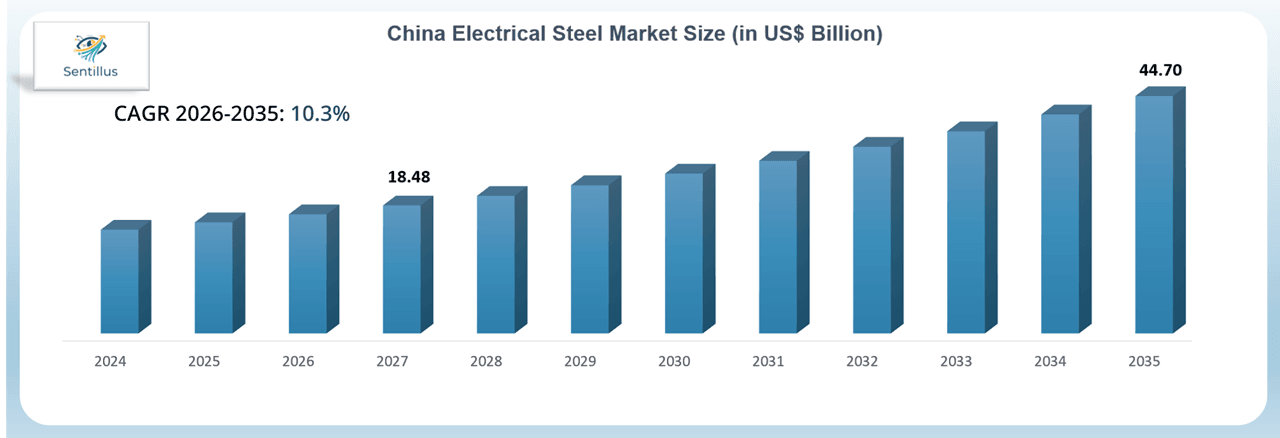
China Electrical Steel Market reached 10,526.40 kilo tons in 2026 and is projected to reach 30,310.04 kilo tons by 2035, expanding at a CAGR of 12.5% during the forecast period 2026-2035. China still dominates the world market for electrical steel through a combination of mass production, investment in grid infrastructure and the manufacture of electric vehicles and electrified industrial machines. The demand for goes far beyond traditional power transmission since electrical steel is becoming more of a strategic material for UHV power transmission systems, renewable energy integration, electric mobility, rail transport and energy-efficient industrial machines. Industrial policy in China has changed from increasing production capacity in order to produce specialized steels that would be able to support the advanced energy and transport systems.
Mass electricity infrastructure investments remain among the most powerful demand drivers. State Grid Corporation of China announced investments of CNY 500 billion in 2024 for improving transmission infrastructure, smart grids and renewable energy integration into the electricity system. Several UHVAC and UHVDC projects are being developed to transmit electricity from renewable energy bases in western China to consumption centers in eastern provinces. This requires high-performance power transformers that need to use grain-oriented electrical steel with very low losses for the core, which opens up opportunities for purchases of such materials by local manufacturers.
At the same time, investments in manufacturing are growing. A new grain-oriented electrical steel manufacturing plant was established by China Baowu Steel Group in June 2024, thus raising total grain-oriented electrical steel production capacity to approximately 1.94 million tons per year, along with introducing ultra-thin high-permeability grades intended for premium transformers. Investments in high-permeability grain-oriented electrical steel made by Taiyuan Iron & Steel (TISCO) and Hunan Valin Steel in 2025 prove industry belief in transformer demand fueled by renewable energy generation and industrial upgrading and export activities.
China’s application mix also reflects changing electricity demand patterns. Data centers, electric vehicles, industrial robotics, railway electrification and intelligent manufacturing systems increasingly require high-efficiency motors and generators utilizing advanced non-grain-oriented electrical steel. Domestic manufacturers continue introducing thinner cold-rolled electrical steel with improved magnetic properties to meet higher efficiency requirements established across automotive and industrial equipment sectors.
Key Takeaways
- Grain-oriented electrical steel currently accounts for approximately 18.5% of China’s electrical steel market because transformer manufacturing remains closely aligned with nationwide transmission expansion and renewable electricity integration.
- Cold-rolled electrical steel represents the fastest-growing processing technology with 12.5% CAGR, supported by continuous investments in premium electrical steel manufacturing and increasing adoption within electric vehicles, industrial motors and precision electrical equipment.
- Transformers remain the fastest-growing application with approximately 25.85% market share, reflecting continuous investment in UHV transmission corridors, renewable energy projects and smart grid modernization throughout the country.
Market Driver
Ultra-High-Voltage Transmission Expansion Strengthens Transformer Demand
China is making investments in one of the largest projects in the world for electricity transmission through construction of UHV transmission corridors connecting renewable energy sources with major consumption centers. In January 2024, State Grid Corporation of China invested CNY 500 billion in its transmission infrastructure, including construction of digital substations, development of smart grids and incorporation of renewable energy into them. It has started constructing a ±800 kV UHVDC transmission corridor from Yan’an to Hefei, which is approximately 1,069 kilometres long and has the capacity to transmit 8 GW of electricity. Transformers of high capacity fitted in converter stations, substations, and switching stations need electrical steel of the highest quality with minimal core losses. Thus, building of UHV infrastructure ensures a constant demand for such products.
Premium Electrical Steel Manufacturing Capacity Expands to Support High-Efficiency Equipment
Chinese steelmakers continue to invest in advanced products, as downstream sectors require efficient electrical equipment. China Baowu Steel Group launched an innovative GOES (grain-oriented electrical steel) production line in June 2024, expanding its production capacity to 1.16 million tons per year and producing ultra-thin products for high-end transformers. Also, TISCO launched a high-permeability grain-oriented electrical steel production line in the first half of 2025, and Hunan Valin Steel added another 100,000 tons production facility for the same products. The domestic capacity increase helps meet the demand of transformer manufacturers and other sectors.
Market Opportunity
Electric Vehicle Manufacturing Creates New Growth Beyond Traditional Utility Applications
China remains the world’s largest electric-vehicle manufacturing base, driving sustained demand for premium non-grain-oriented electrical steel used in traction motors. Higher rotational speeds, compact motor designs and increasing efficiency targets encourage vehicle manufacturers to adopt thinner cold-rolled electrical steel, reducing magnetic losses while improving motor performance. The continued growth of domestic electric car makers like BYD, SAIC Motor, Geely, NIO and XPeng will present opportunities for producers to produce new, higher-grade electrical steel to meet the requirements of high-speed motors. The export of Chinese electric cars will add more value to this as well.
Overseas Infrastructure Development Expands Export Potential for Chinese Electrical Steel
Chinese electrical equipment manufacturers continue participating in international transmission, renewable energy and railway projects through overseas engineering contracts and equipment exports. Expansion of transformer manufacturing capacity enables domestic producers to supply grain-oriented electrical steel not only to Chinese utilities but also to export-oriented transformer manufacturers serving Southeast Asia, the Middle East, Africa and Latin America. Continued development of international electricity infrastructure alongside China’s growing position as a supplier of renewable energy equipment creates opportunities for electrical steel manufacturers to diversify beyond domestic demand while increasing production of higher-value specialty steel products.
Segment Analysis
By Type: Grain-Oriented Electrical Steel Maintains Strategic Importance Through Transmission Infrastructure Development
Grain-oriented electrical steel accounted for 34.6% of China’s electrical steel market since government still focuses its investments on developing high-voltage and ultra-high-voltage power lines. All UHVAC and UHVDC corridors require big power transformers to ensure minimum loss of electricity in the process of transportation. The use of premium grain-oriented electrical steel ensures better magnetic permeability and lower core losses and thus becomes a preferable material for transformer core installation.
The growth in demand for electrical steel is stimulated not only by new power infrastructure development but also by upgrading of old power lines with more efficient ones. Grid operators increasingly specify transformers that comply with stricter efficiency requirements while maintaining operational reliability under continuously changing electricity flows generated by wind and solar power. Expansion of domestic transformer manufacturing by companies including China XD Electric, TBEA and Hitachi Energy China continues supporting procurement of premium grain-oriented electrical steel produced by China Baowu, Shougang Group, TISCO and Hunan Valin Steel. Rising exports of power transformers to developing electricity markets further strengthen production of transformer-grade electrical steel, enabling Chinese manufacturers to increase utilization of newly commissioned high-permeability production lines.
By Manufacturing Process: Cold Rolled Electrical Steel Records the Fastest Growth Through High-Efficiency Manufacturing
Cold-rolled electrical steel is the fastest-growing production process, accounting for 97.48% share due to the increasing demands of downstream industries for more precise and thinner products that possess better magnetic properties. Cold rolling provides better surface finish, improved insulation coating and magnetic properties, making the product appropriate for applications like electric cars and high-quality generators.
Rapid expansion of China’s electric vehicle industry has accelerated adoption of cold rolled non-grain-oriented electrical steel because traction motors operate at significantly higher rotational speeds than conventional industrial motors. Manufacturers also require thinner laminations to reduce eddy current losses and improve vehicle range. Automation equipment, robotics, railway traction systems and energy-efficient industrial machinery are creating additional demand for premium cold rolled products. Investments by Baowu, Shougang and Ansteel in advanced electrical steel production demonstrate continued industry transition toward high-value cold-rolled products rather than conventional carbon steel.
By Application: Transformer Manufacturing Remains the Fastest-Growing
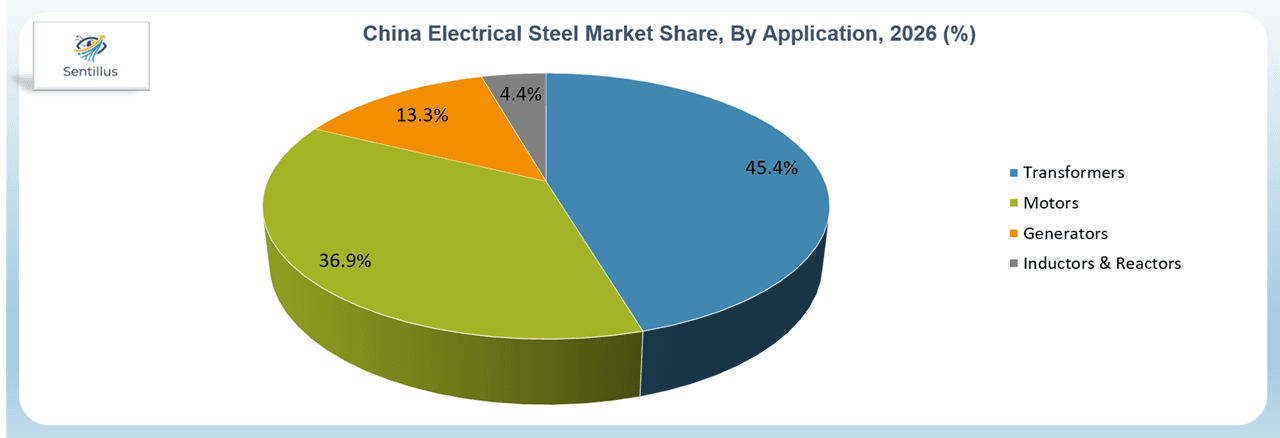
Transformer manufacturing is the fastest-growing end-user, with 39.32% growth due to the increasing need for long-range renewable energy transmission in China’s electric grid network and improvements in substations and grid reliability. For building UHV transmission corridors, several thousand distribution transformers, power transformers, converter transformers, and auxiliary transformers will be required for each stage of electricity transmission process.
Another reason for the rising demand for transformers is that integration of renewable energy sources means that solar plants, offshore wind power plants, battery energy storage systems, and industrial microgrids require installation of transformers before connecting to the transmission network. Electrification of industries and commercial buildings also results in more demand for medium-voltage distribution transformers. Increased manufacturing of transformers helps in procuring high-quality grain-oriented electrical steel.
Competitive Landscape
Competition within China’s electrical steel market combines large integrated steel producers with specialized transformer and electrical equipment manufacturers. Production capability, technology leadership, high-permeability electrical steel development, export strength and downstream integration determine competitive positioning rather than manufacturing scale alone.
- China Baowu Steel Group remains the market leader through its Baosteel subsidiary, benefiting from the country’s largest grain-oriented electrical steel production capacity, advanced research capabilities and long-term supply relationships with transformer manufacturers serving domestic and export markets.
- Shougang Group has established a strong position within premium non-grain-oriented electrical steel for electric vehicles and industrial motors. Continuous investment in high-grade electrical steel has strengthened its participation in automotive electrification and industrial automation.
- TISCO (Taiyuan Iron & Steel) continues expanding production of high-permeability grain-oriented electrical steel, improving its competitiveness within transformer manufacturing following commissioning of new production capacity during 2025.
- Valin Steel Hunan has increased its market presence by developing quality Hi-B Grain-Oriented Electrical Steel to cater to manufacturers of transformers who need low magnetic losses and high efficiency.
- China XD Electric is among the biggest manufacturers of transformers and high-voltage equipment in China. Active involvement in projects from the State Grid Company ensures steady demand for transformer steel.
- TBEA maintains a significant presence across transformer manufacturing, renewable energy equipment and transmission infrastructure. International EPC activities strengthen demand for domestically produced electrical steel utilized in export-oriented transformer production.
- Hitachi Energy China continues expanding manufacturing capability for high-voltage transformers and digital grid equipment, supplying utilities and industrial customers requiring premium transformer technologies.
- Ansteel Group remains an important supplier of electrical steel serving automotive manufacturers, industrial equipment producers and appliance manufacturers, with increasing emphasis on higher-value specialty steel production.
Key Companies
- thyssenkrupp AG
- POSCO
- ArcelorMittal
- NIPPON STEEL CORPORATION
- JFE Steel Corporation
- Tata Steel
- Voestalpine Stahl GmbH
- United States Steel Corporation
- Cleveland-Cliffs Inc.
- Shougang
- JSW Steel
BCG Matrix
| Category | Companies | Positioning Analysis |
| Stars | China Baowu Steel Group, China XD Electric | Strong domestic manufacturing capability, leadership in State Grid projects, advanced technology and significant participation in transformer production position both companies as market leaders with high future growth potential. |
| Cash Cows | TBEA, Shougang Group | Established customer relationships, diversified product portfolios and mature manufacturing operations generate stable revenue while maintaining strong positions within domestic and export markets. |
| Question Marks | TISCO, Hunan Valin Steel | Recent investment in premium grain-oriented electrical steel provides substantial long-term opportunity, although market share continues developing as production ramps up and customer qualification expands. |
| Dogs | Ansteel Group, regional specialty steel processors focused primarily on conventional products | Stable manufacturing capability exists, although participation within premium transformer-grade electrical steel remains comparatively limited against leading domestic competitors. |
Adoption Analysis
China’s adoption of premium electrical steel has accelerated as industrial customers increasingly evaluate lifetime operating efficiency rather than initial equipment cost. Utility companies prioritize transformers capable of reducing transmission losses throughout decades of continuous operation, encouraging broader use of high-permeability grain-oriented electrical steel across transmission infrastructure.
Electric vehicle manufacturers have simultaneously accelerated adoption of premium non-grain-oriented electrical steel because higher motor efficiency directly improves driving range and vehicle performance. Industrial automation, robotics, railway electrification and precision manufacturing systems are creating additional demand for thinner electrical steel laminations capable of supporting high-speed motor operation. Growing deployment of intelligent factories under China’s manufacturing modernization strategy further reinforces adoption of premium electrical steel across multiple industrial sectors.
Disruption Analysis
China’s electrical steel industry is undergoing structural transformation driven by changing electricity generation, transportation and manufacturing technologies. Conventional demand associated with household appliances and traditional industrial equipment is gradually being complemented by high-growth applications including electric mobility, renewable energy equipment, battery storage systems and digital electricity infrastructure.
Manufacturing technology development is progressing hand-in-hand. Increasingly, steel manufacturers are using modern continuous annealing, laser domain refining and ultra-thin rolling technology to develop better-performing electrical steel with reduced magnetic losses. Domestic substitution for imported high-quality electrical steel has further become stronger because of improvements in domestic manufacturing quality and decreased reliance on foreign specialized steel.
Another structural shift is occurring through export diversification. Chinese electrical steel producers are expanding participation within overseas transformer manufacturing, renewable energy infrastructure and railway electrification projects, reducing dependence on domestic electricity investment while increasing production of higher-value specialty products.
Regulatory Landscape
The regulation of electrical steel products market in China is through a regime that consists of components such as industrial policy, product standards, and power infrastructure development. This regime is shared among various government organizations, which include MIIT (Ministry of Industry and Information Technology), NEA (National Energy Administration), SAMR (State Administration for Market Regulation) and SAC (Standardization Administration of China). Each institution influences electrical steel demand from a different perspective, ranging from transmission infrastructure planning to manufacturing quality and equipment efficiency.
The National Energy Administration directs long-term electricity infrastructure development through national power planning and approval of major transmission projects. The expansion of ultra-high-voltage transmission corridors, renewable energy integration and interprovincial electricity trading continues to increase the procurement of transformer equipment requiring premium grain-oriented electrical steel. National planning also prioritizes modernization of the electricity network to improve system reliability while accommodating higher renewable generation capacity.
Manufacturing quality is governed through Chinese GB (Guobiao) standards developed by the Standardization Administration of China. Standards applicable to electrical steel, power transformers and rotating electrical machines establish technical requirements covering magnetic properties, dimensional tolerances, insulation coating performance and testing procedures. Compliance with these standards encourages wider adoption of premium electrical steel grades capable of meeting increasingly demanding efficiency requirements across industrial and utility applications.
Industrial development is further supported through MIIT’s implementation of the 14th Five-Year Plan for the Raw Materials Industry, which identifies advanced specialty steels, including high-grade electrical steel, as priority materials supporting strategic industries such as new energy vehicles, renewable energy equipment, intelligent manufacturing and high-end electrical equipment. Policy support encourages domestic manufacturers to increase production of ultra-thin non-grain-oriented electrical steel and high-permeability grain-oriented electrical steel while reducing dependence on imported specialty materials.
Equipment efficiency requirements also continue strengthening through national energy conservation policies and motor efficiency initiatives. Manufacturers supplying industrial motors, generators and electrical equipment increasingly specify higher-grade electrical steel to achieve efficiency targets established for industrial electrification and carbon reduction. Regulatory emphasis therefore extends beyond steel manufacturing into downstream equipment performance, supporting long-term consumption of premium electrical steel throughout China’s industrial economy.
Key Developments
- Taiyuan Iron & Steel (TISCO) inaugurated an 80,000-tonnes high-permeability grain-oriented electrical steel plant, thereby boosting domestic production for producing high-efficiency transformers.
- Hunan Valin Steel put a 100,000-tonnes Hi-B grain-oriented electrical steel production line into commercial use.
- November 2023 – Shougang Group announced that annual production capacity for high-grade non-grain-oriented electrical steel reached 550,000 tons, while total electrical steel capacity is expected to reach 2.2-2.3 million tons, with high-end products accounting for more than 70% of production. The expansion strengthens China’s domestic supply of premium electrical steel for electric vehicles and industrial motors.
- November 2024 – ArcelorMittal and China Oriental Group agreed on a joint venture for the construction of a plant to manufacture 2.5 million tonnes of electrical steel in Tangshan in Hebei Province. The project involves investing in soft magnetic materials used for the production of new energy vehicles, industrial motors and renewable energy equipment.
- March 2024 – China State Grid Corporation began the construction of the ±800 kV UHVDC transmission line project between Yan’an and Hefei, which is 1,069 km long with a capacity of 8 GW. This project requires the production of converter transformers using premium grain-oriented electrical steel.
- January 2024 – China State Grid Corporation unveiled an investment plan worth CNY 500 billion for the development of power transmission infrastructure, digital substations, and smart grid implementation. It also indicated an increased long-term requirement for premium transformer-grade electrical steel.
- November 2023 – Shougang Group revealed its annual production capacity of high-grade non-grain-oriented electrical steel to be at 550,000 tons, while the total electrical steel capacity would be 2.2-2.3 million tons, with high-end products making up more than 70% of the total production capacity. This development would boost the availability of premium electrical steel in China for manufacturing electric cars and industrial motors.
Future Outlook
China Electrical Steel Market reached US$ 17.57 Billion in 2026 and is projected to reach US$ 34.74 Billion by 2035, expanding at a CAGR of 10.2% during the forecast period 2026-2035. China’s electrical steel market is expected to remain technology-driven rather than volume-driven throughout the forecast period as manufacturers prioritize premium products supporting strategic industries. Future growth is likely to be shaped by three structural transitions: expansion of intelligent electricity networks, electrification of transportation and continued industrial modernization.
Transmission infrastructure will remain an important source of demand as additional ultra-high-voltage corridors connect renewable energy bases with coastal industrial regions. Digital substations, flexible transmission systems and advanced power electronics will require transformers capable of achieving progressively lower operating losses, supporting continued investment in high-permeability grain-oriented electrical steel.
Electric mobility is expected to generate another major growth avenue. Increasing production of battery electric vehicles, hybrid vehicles, electric buses and commercial vehicles will encourage wider adoption of ultra-thin non-grain-oriented electrical steel designed for high-speed traction motors. Higher efficiency requirements and export-oriented vehicle manufacturing are likely to accelerate the development of premium electrical steel grades with improved magnetic performance.
Industrialization also provides long-term opportunities. As robotics, smart manufacturing, high-speed rail, industrial automation and precision machines become more commonplace, there is an increasing need for motors that operate efficiently enough to cut back on power usage without sacrificing reliability. Domestic manufacturers that develop sophisticated technology for rolling, annealing and coating should help bolster China’s standing in the international specialty electrical steel market.
The competition will be based not only on scale but also on performance and innovations. Companies capable of combining advanced electrical steel production with downstream partnerships across transformer manufacturing, electric mobility and renewable energy equipment are expected to strengthen their competitive position as China’s energy transition and industrial upgrading continue to reshape demand for premium electrical steel.
Market Scope
| Segment | Material Type | Silicon Content | Product Form | Manufacturing Technology |
| Details | Grain-Oriented Non-Grain-Oriented | Low Silicon (<2%) Medium Silicon (2-3%) High Silicon (3-6.5%) | Sheets Coils Strips Others | Cold Rolled Hot Rolled |
| Segment | Power Rating | Thickness | Application | End-User |
| Details | Low Power (<1 kW) Medium Power (1 kW-100 kW) High Power (>100 kW) | Thick Gauge (>0.5 mm) Medium Gauge (0.3-0.5 mm) Thin Gauge (0.2-0.3 mm) Ultra-Thin (<0.2 mm) | Transformers Motors Generators Inductors & Reactors | Energy & Power Automotive Industrial Manufacturing Household Appliances Construction & Infrastructure |
Who Should Buy This Report in 2026?
The Sentillus China Electrical Steel Market Report (2026 Edition) is designed for organizations involved in electrical steel production, transformer manufacturing, electric motor and generator manufacturing, power transmission, renewable energy, electric mobility, industrial equipment and strategic investment across global markets.
Electrical Steel Manufacturers
Identify demand opportunities across grain-oriented and non-grain-oriented electrical steel, benchmark competing producers, evaluate capacity expansion strategies and understand evolving requirements from transformer, motor and generator manufacturers.
Transformer Manufacturers
Assess electrical steel demand linked to power transformer and distribution transformer production, evaluate material performance requirements and understand procurement trends associated with grid modernization, renewable energy integration and transmission infrastructure development.
Electric Motor and Generator Manufacturers
Analyze demand for non-grain-oriented electrical steel across motors, generators and industrial electrical equipment while evaluating material efficiency, energy-loss requirements, technology developments and evolving manufacturing standards.
Power Utilities and Grid Infrastructure Companies
Understand electrical steel demand associated with transformer replacement, transmission network expansion, distribution infrastructure modernization and renewable power integration to support long-term procurement and infrastructure planning.
Renewable Energy Equipment Manufacturers
Evaluate opportunities linked to wind power generators, solar power infrastructure, grid-connected equipment and energy storage systems requiring high-efficiency electrical components and advanced magnetic materials.
Electric Vehicle and Automotive Component Manufacturers
Assess demand for non-grain-oriented electrical steel used in traction motors, electric vehicle drivetrains and high-efficiency automotive electrical systems while tracking light weighting, energy-efficiency and motor technology trends.
Steel Producers and Specialty Steel Companies
Benchmark competitive positioning, assess opportunities in premium grain-oriented and high-performance non-grain-oriented electrical steel, evaluate production investments and identify emerging applications across energy and mobility markets.
Industrial Equipment Manufacturers
Analyze material requirements for industrial motors, compressors, pumps, generators and other electrically powered machinery while assessing opportunities arising from industrial automation, energy efficiency and equipment modernization.
Government Agencies and Energy Regulators
Understand electrical steel demand drivers associated with grid expansion, energy transition policies, renewable power deployment, industrial development and energy-efficiency initiatives influencing regional markets.
Investors, Private Equity and Corporate Strategy Teams
Identify capacity expansion opportunities, evaluate strategic investments, benchmark major producers, assess regional supply-demand dynamics and analyze long-term opportunities across the global electrical steel value chain.
Research Institutions and Technology Developers
Support research into high-efficiency magnetic materials, advanced steel processing, reduced core losses, electric motor technologies, transformer efficiency and next-generation electrical equipment applications.
Frequently Asked Questions
Electrical steel is a critical functional material used in magnetic cores where energy efficiency and electromagnetic performance directly influence equipment performance. Its role across transformers, motors, generators and other electrical equipment makes developments in power infrastructure, industrial electrification and electric mobility important considerations when assessing future demand.
Companies evaluating the electrical steel market should consider product specifications, application requirements, regional manufacturing capabilities, customer industries, technology requirements, supply availability and competitive positioning. Assessment of demand drivers alongside production capabilities and end-use developments helps identify commercially relevant opportunities rather than relying only on headline market growth.
Transformer manufacturing is closely connected with electrical steel because the material forms a functional component of transformer magnetic cores. Changes in grid investment, renewable power integration, transmission expansion and transformer replacement cycles can therefore influence procurement requirements for electrical steel producers and downstream manufacturers.
Electric vehicle adoption affects electrical steel demand through the increasing requirement for high-efficiency traction motors and associated electrical components. Motor manufacturers increasingly require materials capable of supporting efficiency, power density and thermal-performance objectives, making electrical steel specifications an important consideration in electric drivetrain development.
Premium grades can provide improved magnetic performance and lower energy losses compared with conventional materials. Commercial relevance therefore extends beyond volume demand and includes applications where equipment efficiency, operating performance and lifecycle energy consumption are important purchasing criteria.
Market development can be influenced by raw-material availability, production technology requirements, energy-intensive manufacturing processes, qualification requirements, supply-chain concentration and the technical specifications demanded by transformer and motor manufacturers. Capacity expansion also requires significant technical expertise because product consistency and magnetic performance are critical to downstream applications.
Opportunity assessment requires analysis across application demand, product requirements, regional manufacturing activity and customer industries. Evaluating where transformer investment, electric mobility, industrial automation and renewable-energy infrastructure are generating new equipment requirements can help manufacturers prioritize applications with stronger structural demand potential.
The report is designed to support decisions related to market entry, capacity planning, product positioning, geographic expansion, competitive assessment, customer targeting and investment evaluation. Its value lies in connecting market dynamics with segmentation, regional conditions, competitive developments and industry-level opportunities.
Yes. The study can be customized to address specific geographic markets, countries, product categories, applications, competitors, historical periods or forecast requirements. Customization can be structured around the client’s commercial objective rather than being limited to the standard report framework.
Yes. A sample can be requested to assess the report’s structure, analytical approach, segmentation and level of detail before purchase. Clients can also discuss specific information requirements with the Sentillus research team during the evaluation process.
Yes. The competitive assessment examines relevant industry participants and their market positioning, strategic developments, product capabilities and other factors relevant to competitive evaluation. The depth of company analysis can also be expanded through customization where required.
Yes. Sentillus analysts can provide clarification on the methodology, market definitions, segmentation, assumptions and analytical findings included in the purchased study. Additional analyst discussions can also be considered where a customized research requirement has been commissioned.
Why Choose Sentillus?
Decision-Oriented Research
Sentillus delivers research designed for business decisions rather than information collection. Every study combines industry expertise, strategic analysis and practical market intelligence supporting investment, expansion and competitive planning.
Reliable Primary and Secondary Validation
Research integrates interviews with industry participants including manufacturers/service providers, dealers/distributors/agents/3rd-party suppliers and customers/consumers, public company disclosures, government publications, trade associations, consortiums, paid databases and verified industrial databases to improve analytical reliability.
Consultant-Level Industry Analysis
Every report explains why market changes occur, how competitive dynamics evolve and which developments create future business opportunities rather than simply presenting historical information.
Customized Business Intelligence
Clients receive research tailored to strategic priorities including market entry assessment, competitive benchmarking, supplier evaluation, investment opportunity analysis, pricing assessment and technology landscape studies.
Practical Competitive Insights
Competitive evaluation extends beyond company profiles by examining manufacturing capabilities, expansion strategies, product positioning, innovation priorities and strategic partnerships influencing industry leadership.
Comprehensive Regional Coverage
Country-level analysis evaluates industrial development, manufacturing capacity, production & yield, infrastructure investment, regulatory changes, trade activity and demand outlook across major global markets.
Continuous Research Support
Consultant assistance helps clients interpret findings, clarify market developments and understand industry trends after report delivery, ensuring greater value throughout the decision-making process.
High-Quality Research Standards
Every report follows a structured research methodology emphasizing data accuracy, logical analysis, clear business communication and actionable recommendations suitable for executives, investors and strategy planning teams.