
Executive Summary
The automotive testing market comprises laboratory, proving-ground, virtual simulation and certification services used to validate vehicles, components and software before commercial deployment. Testing has expanded from traditional crash-worthiness and emissions assessment to include battery safety, ADAS, functional safety, cybersecurity, electromagnetic compatibility (EMC) and software validation as vehicle architectures become increasingly electrified and software-defined. Modern development programs integrate physical testing with digital engineering and virtual validation to reduce prototype iterations and accelerate homologation.
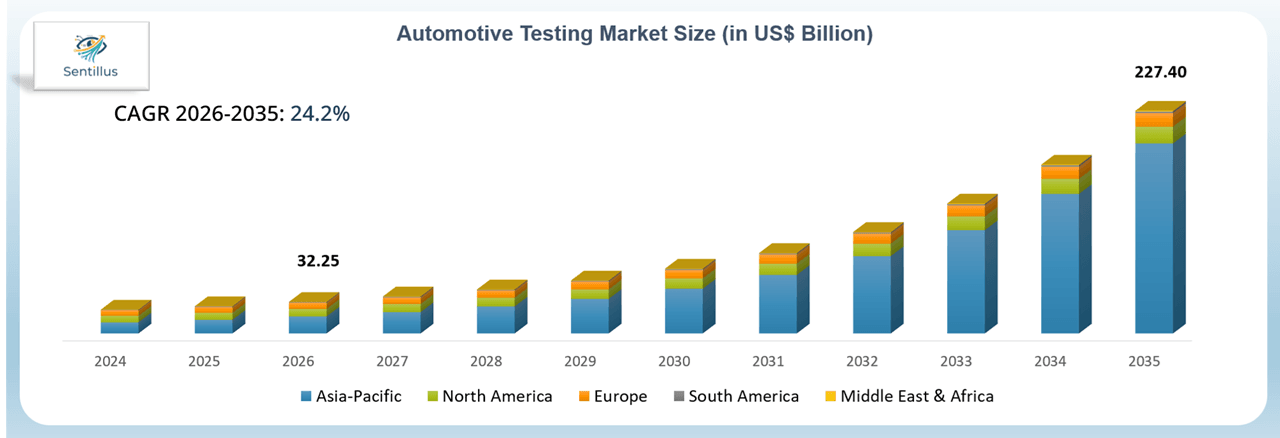
According to Sentillus estimates, the global automotive testing market was valued at USD 32.25 billion in 2026 and is projected to reach USD 227.40 billion by 2035, registering a 24.2% CAGR. Asia-Pacific represents the largest regional market due to its concentration of vehicle manufacturing, battery production and automotive electronics, while North America and Europe maintain strong demand through advanced engineering capabilities and stringent regulatory frameworks.
Electrification continues to broaden testing requirements beyond conventional powertrain validation. Battery packs, high-voltage systems, charging infrastructure and battery management systems require extensive mechanical, electrical, thermal and environmental verification before commercialization. Simultaneously, connected and autonomous vehicles have increased demand for cybersecurity, functional safety and over-the-air software validation under international regulatory frameworks such as UNECE UN R155, UN R156 and ISO 26262. Testing providers are therefore expanding capabilities in battery laboratories, EMC facilities, digital simulation and integrated homologation to support increasingly complex vehicle development programs.
Market Driver
Expanding Global Safety and Cybersecurity Regulations Increase Multi-Disciplinary Vehicle Validation Requirements
Automotive regulations are increasingly extending beyond crash safety and emissions compliance to cover cybersecurity, software updates, automated driving systems and functional safety. UNECE UN R155 mandates Cybersecurity Management Systems, while UN R156 requires Software Update Management Systems for vehicle type approval in participating markets. Growing adoption of ISO 26262 and ISO/SAE 21434 has also increased independent verification of electrical, electronic and software systems throughout vehicle development.
Regulatory expansion has increased demand for integrated testing covering laboratory validation, simulation, proving-ground evaluation and homologation rather than standalone component testing. Manufacturers are engaging accredited testing organizations earlier in product development to reduce certification risks, shorten approval timelines and support simultaneous vehicle launches across multiple international markets. Such regulatory evolution continues to strengthen demand for advanced testing services covering battery systems, ADAS, cybersecurity and connected vehicle technologies.
Market Opportunity
Expansion of Independent EV Battery and Software Validation Infrastructure Creates Long-Term Revenue Opportunities
Electric vehicle development is increasing demand for specialized testing services that extend beyond conventional vehicle validation. Battery manufacturers, OEMs and Tier-1 suppliers require independent laboratories capable of evaluating battery safety, charging interoperability, environmental durability and high-voltage electrical systems before commercial deployment. Regulatory adoption of UNECE R100, UN R155, UN R156 and ISO/SAE 21434 has also created opportunities for third-party providers offering battery certification, cybersecurity assessment and software validation. Expanding EV production, over-the-air software updates and connected vehicle platforms are encouraging testing organizations to invest in battery abuse laboratories, digital simulation, AI-assisted engineering and integrated homologation services. Providers capable of offering complete validation programs from component testing through vehicle certification are well positioned to capture higher-value contracts while reducing development complexity for global manufacturers.
Segment Analysis
By Application: Passenger Vehicles Lead Testing Demand Through Higher Production Volumes and Technology Integration
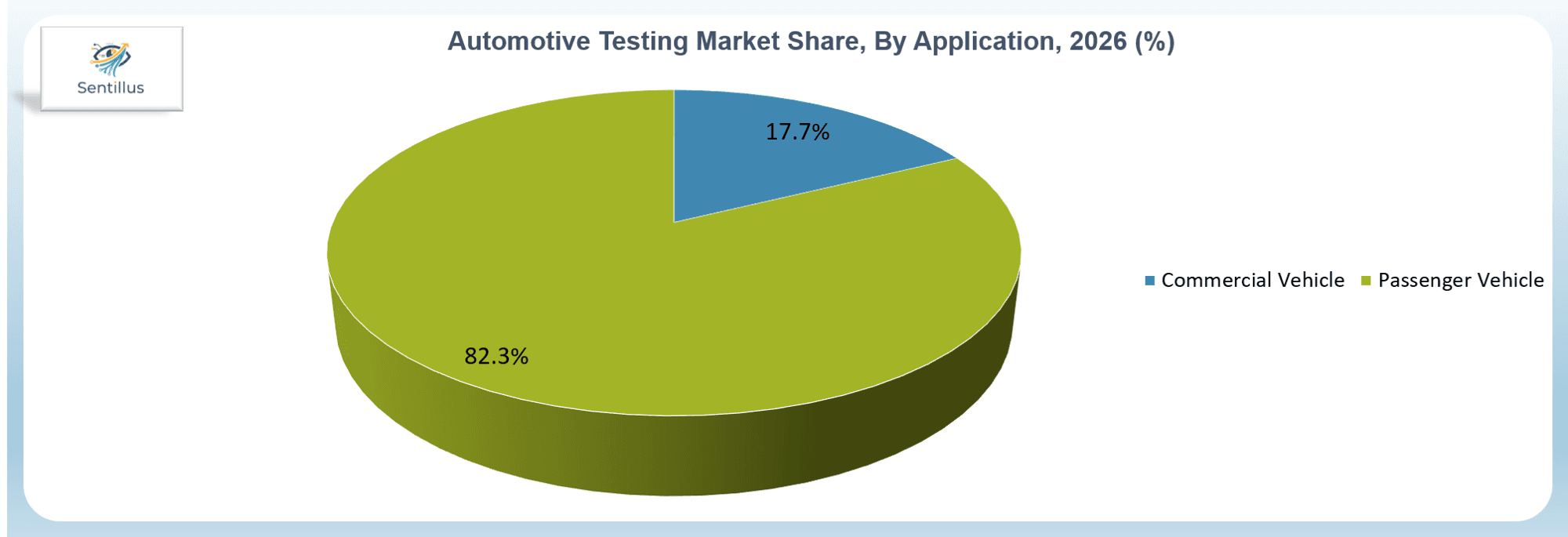
Passenger vehicles account for the largest share of testing activities because they combine high production volumes with rapid adoption of advanced safety, connectivity and electrification technologies. Modern passenger cars integrate ADAS, battery management systems, infotainment platforms, connected services and complex electronic architectures that require extensive laboratory and proving-ground validation before commercialization. Commercial vehicles remain an important segment, particularly for durability, powertrain, braking and fleet performance testing, while electrification of light commercial vehicles is increasing demand for battery safety, charging interoperability and high-voltage component validation.
By Type: Electrical Components and Electronics Dominates the Market Through Increasing Electronic Content and Regulatory Compliance
Electrical Components and Electronics represent the largest service category because every modern vehicle incorporates electronic control units, sensors, communication modules, infotainment systems and safety electronics requiring validation before production. Testing includes EMC, battery checks, durability tests, environmental simulations, vibration analysis, and ingress protection. It also covers telematics and wireless communication to ensure reliable operation in many conditions. Growing semiconductor integration, connected vehicle architectures and advanced driver assistance systems continue expanding the scope of electrical validation beyond component performance toward complete system interoperability. International standards governing electromagnetic compatibility and functional safety have further increased demand for accredited laboratories capable of supporting global homologation programs. Leading participants include Rohde & Schwarz, TÜV Rheinland, SGS, Intertek, HORIBA and Anritsu, which continue expanding capabilities across EMC, battery testing and electronic system validation.
By Product Type: Vehicle Emission Testers Maintain the Largest Installed Base While Battery Analyzers Record Faster Adoption
Vehicle emission testers continue to account for the largest installed equipment base due to mandatory emissions compliance across passenger and commercial vehicle production. Engine dynamometers, chassis dynamometers and gas analyzers remain essential for validating engine performance, fuel efficiency and regulatory compliance. Battery analyzers, durability testers and vibration testing equipment are recording faster deployment as manufacturers expand electric vehicle programs and require comprehensive validation of high-voltage battery systems, charging components and electric drivetrains. Modern testing laboratories increasingly integrate multiple equipment platforms into automated digital environments, improving testing accuracy, reducing development time and supporting higher laboratory utilization.
Regional Analysis
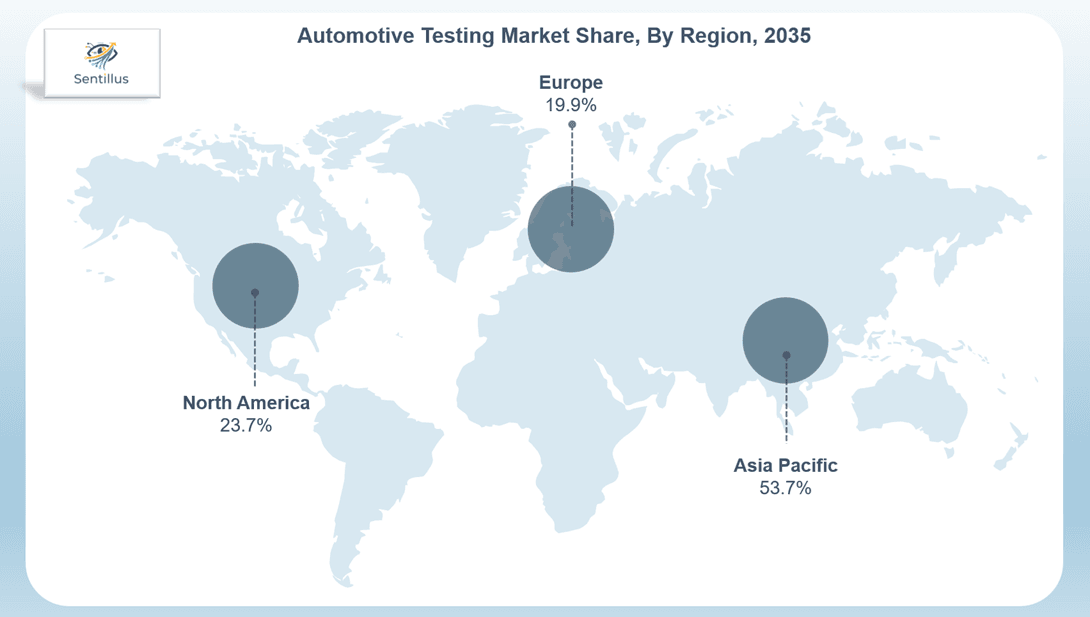
United States Maintains Regional Leadership Through Advanced Validation Infrastructure and High-Value Vehicle Development
The United States represents the largest automotive testing market in North America, accounting for USD 5,798.74 million in 2026 and projected to reach USD 11,579.05 million by 2035, reflecting a CAGR of 8.0% according to Sentillus estimates. Demand is supported by the country’s extensive network of OEMs, Tier-1 suppliers and independent testing organizations serving passenger vehicles, commercial vehicles and emerging mobility platforms. Michigan, Ohio, Indiana, Tennessee and South Carolina remain major automotive manufacturing hubs where continuous product development generates sustained demand for crash testing, durability evaluation, emissions certification and component validation. Expansion of domestic electric vehicle production and battery manufacturing has also increased laboratory requirements for battery safety, charging interoperability and high-voltage system validation, strengthening long-term demand for integrated testing and homologation services.
China Emerges as the Fastest-Expanding Market Through Large-Scale Electric Vehicle Manufacturing
China is projected to increase from USD 9,320.85 million in 2026 to USD 124,945.98 million by 2035, registering the highest CAGR among major markets at 33.4%. Strong domestic production of electric vehicles, batteries, power electronics and automotive semiconductors continues to expand demand for battery testing, EMC evaluation and intelligent vehicle validation. Export-oriented manufacturers increasingly require compliance with international certification requirements alongside domestic standards, encouraging investment in advanced testing laboratories capable of supporting both local approval and global vehicle homologation. Continued localization of battery production and connected vehicle technologies is expected to sustain high utilization of testing facilities throughout the forecast period.
Germany Benefits from Premium Vehicle Manufacturing and Engineering-Intensive Development Programs
Germany is expected to grow from USD 1,624.40 million in 2026 to USD 3,598.77 million by 2035, at a CAGR of 9.2%. Premium passenger vehicle production and advanced engineering activities continue to generate strong demand for powertrain testing, battery validation, EMC assessment and vehicle homologation. Development programs for luxury vehicles typically require more comprehensive validation due to higher electronic content, advanced driver assistance features and stringent quality requirements. Independent testing organizations also benefit from close collaboration with OEM engineering centers, supporting continuous demand for laboratory services throughout vehicle development rather than only during final certification.
India Records Strong Growth Supported by Expanding Automotive Manufacturing and EV Development
India is forecast to increase from USD 1,841.82 million in 2026 to USD 25,310.93 million by 2035, representing a CAGR of 33.8%, the highest among major automotive manufacturing economies. Growth is supported by expanding passenger vehicle production, increasing component exports and rising investment in electric mobility. National testing organizations including ARAI and ICAT continue strengthening certification capabilities for electric vehicles, battery systems, emissions compliance and safety validation. Increasing localization of vehicle manufacturing is encouraging suppliers to perform validation activities domestically, reducing certification lead times while improving access to internationally recognized testing services.
Japan Sustains Demand Through Advanced Powertrain Development and High Reliability Standards
Japan is expected to expand from USD 4,497.00 million in 2026 to USD 36,261.61 million by 2035, registering a CAGR of 26.1%. Long-established expertise in vehicle engineering continues to support demand for endurance testing, hybrid powertrain validation, battery reliability assessment and environmental simulation. Domestic manufacturers maintain rigorous product quality requirements, resulting in extensive lifecycle testing before commercial production. Continued investment in electrified mobility and next-generation propulsion technologies is also increasing demand for integrated validation covering electric drivetrains, battery systems and advanced electronic components.
Competitive Landscape
The automotive testing market remains moderately fragmented, with global competition led by multinational testing, inspection and certification organizations alongside specialized engineering companies and national research institutes. Large providers differentiate themselves through international accreditation, broad laboratory networks, proving-ground infrastructure and the ability to deliver engineering, validation and homologation services within a single development program. Such integrated capabilities reduce certification complexity for OEMs launching vehicles across multiple international markets while strengthening long-term customer relationships.
Electrification, software-defined vehicles and connected mobility are reshaping competitive positioning. Companies with expertise in battery testing, functional safety, cybersecurity, ADAS validation and digital engineering are expanding faster than providers focused solely on conventional mechanical testing. Investment priorities increasingly emphasize battery laboratories, EMC facilities, virtual validation platforms and AI-assisted engineering, reflecting the industry’s transition toward software-intensive vehicle development.
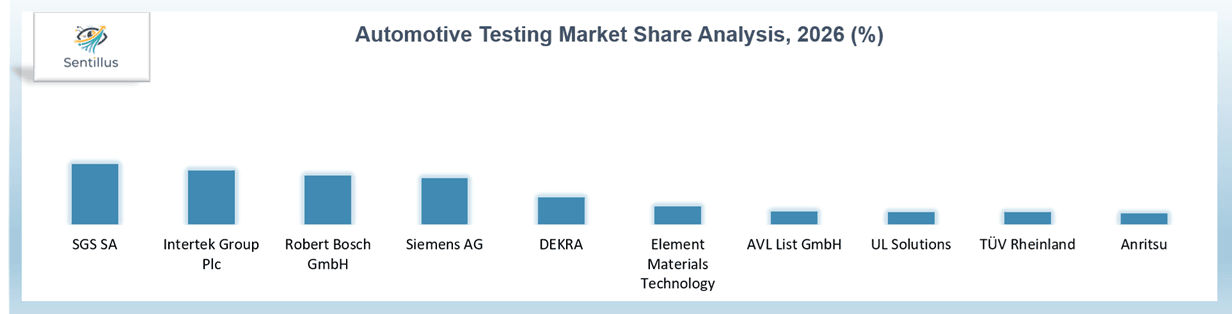
Key Market Participants
TIC Leaders
- SGS
- DEKRA
- TÜV Rheinland
- Bureau Veritas
- Intertek
- UL Solutions
- Applus+
Engineering Specialists
- AVL
- HORIBA
- Bosch
- Siemens
- D&V Electronics
Research Institutes
Laboratory Specialists
BCG Matrix
| Quadrant | Companies | Strategic Position |
| Stars | SGS SA, DEKRA, TÜV Rheinland, Applus+, AVL List GmbH | Strong global presence supported by broad testing portfolios covering electrification, homologation, ADAS, battery validation and connected vehicle technologies. Continuous investment in advanced laboratories and digital validation platforms positions these companies to benefit from next-generation mobility programs. |
| Cash Cows | HORIBA, Intertek Group plc, Bureau Veritas, UL Solutions | Established customer relationships, accredited testing capabilities and recurring certification contracts generate stable revenue across conventional powertrain, emissions, materials and safety testing while gradually expanding into electric vehicle applications. |
| Question Marks | Rohde & Schwarz, D&V Electronics, Element Materials Technology, Centre Testing International (CTI), ICAT | Growing participation in EMC, battery systems, automotive electronics and regional certification provides attractive expansion opportunities, although geographic reach and service portfolios remain narrower than global TIC leaders. |
| Niche Players | ARAI, Automotive Test Systems, Sigma Test & Research Centre, URS Products & Testing Pvt. Ltd., Auto Technic Japan | Strong domestic expertise and specialized technical capabilities support regional manufacturers and regulatory agencies, although international expansion remains comparatively limited. |
Regulatory Landscape
| Country/Region | Regulation / Standard | Regulatory Authority | Commercial Impact |
| Global | UN Regulation No. 155 – Cybersecurity Management System | UNECE WP.29 | Requires cybersecurity assessment and certification before vehicle type approval in participating countries. |
| Global | UN Regulation No. 156 – Software Update Management System | UNECE WP.29 | Expands testing requirements for over-the-air software updates and lifecycle compliance. |
| Global | UN Regulation No. 100 | UNECE WP.29 | Defines safety requirements for high-voltage electric powertrains and battery systems. |
| Global | ISO 26262 | International Organization for Standardization (ISO) | Establishes functional safety requirements for electrical and electronic vehicle systems. |
| Global | ISO/SAE 21434 | ISO / SAE International | Standardizes cybersecurity engineering throughout the automotive product lifecycle. |
| European Union | Regulation (EU) 2018/858 | European Commission | Governs vehicle type approval and market surveillance for motor vehicles across the European Union. |
| United States | Federal Motor Vehicle Safety Standards (FMVSS) | National Highway Traffic Safety Administration (NHTSA) | Defines mandatory vehicle safety performance requirements before commercialization. |
| United States | Light-Duty Greenhouse Gas Emissions Standards | U.S. Environmental Protection Agency (EPA) | Requires emissions and fuel economy validation for passenger vehicles. |
| India | Central Motor Vehicles Rules (CMVR) | Ministry of Road Transport and Highways | Establishes homologation, safety and emissions compliance requirements for vehicles manufactured or sold in India. |
| China | GB Vehicle Standards | State Administration for Market Regulation (SAMR) | Defines mandatory technical and safety requirements for vehicles and automotive components. |
Key Developments
| Month | Year | Company | Development | Commercial Impact |
| February | 2025 | SGS-TÜV Saar | Received DAkkS accreditation for Functional Safety and Cybersecurity certification. | Expanded accredited certification services for software-defined vehicles. |
| June | 2025 | SGS-TÜV Saar | Issued the first AI safety process certification based on ISO/PAS 8800 for Geely Auto. | Strengthened commercial opportunities in AI validation and autonomous vehicle safety. |
| September | 2025 | SGS-TÜV Saar | Formed a partnership with Brightsight by SGS for automotive cybersecurity assessment. | Expanded cybersecurity testing and certification capabilities. |
| November | 2025 | Applus+ IDIADA | Received designation under the Great Britain Type Approval Scheme. | Enhanced homologation capability for manufacturers targeting the UK market. |
| December | 2025 | Applus+ IDIADA | Expanded New Generation eCall certification services. | Supported increasing validation requirements for connected vehicle communication systems. |
| April | 2026 | Applus+ IDIADA | Introduced AI-assisted CAE engineering workflows. | Reduced engineering validation time and prototype iterations. |
| May | 2026 | DEKRA | Expanded the Brandenburg Battery Test Center in Germany. | Increased European battery testing capacity for electric vehicles. |
Future Outlook
Automotive testing will increasingly transition from conventional mechanical validation toward integrated verification covering software, electronics and connected mobility. Battery technologies with higher energy density, next-generation charging systems and software-defined vehicle architectures will require broader validation programs spanning electrical safety, cybersecurity, environmental durability and lifecycle software management. Virtual engineering, digital twins and artificial intelligence are expected to reduce prototype dependence while improving engineering efficiency through earlier design verification.
Regional investment is likely to shift toward Asia-Pacific as vehicle production, battery manufacturing and automotive electronics continue expanding across China, India and Southeast Asia. North America and Europe are expected to maintain leadership in advanced validation services associated with autonomous driving, functional safety and cybersecurity because of mature regulatory frameworks and strong research capabilities. Independent testing providers offering engineering support, simulation, laboratory validation and homologation through a single platform are expected to gain competitive advantage as manufacturers seek shorter development cycles and streamlined international certification. Continued regulatory updates governing automated driving, connected vehicles and battery safety will sustain recurring demand for accredited testing organizations while creating opportunities for specialized laboratories focused on emerging mobility technologies.
Who Should Buy This Report in 2026?
The Sentillus Automotive Testing Market Report (2026 Edition) is designed for organizations involved in vehicle development, testing, certification, compliance, manufacturing, quality assurance, infrastructure development and automotive technology innovation across global markets.
Automotive OEMs
Evaluate testing strategies for conventional, electric, hybrid and autonomous vehicles, benchmark industry practices, understand regulatory compliance requirements and optimize vehicle development programs across global markets.
Tier-1 and Tier-2 Automotive Suppliers
Identify evolving testing requirements for powertrain systems, batteries, electronics, ADAS components, braking systems, tires, safety equipment and vehicle software while aligning product development with OEM quality standards.
Automotive Testing Service Providers
Benchmark competitive positioning, identify emerging service opportunities, evaluate laboratory expansion strategies and understand future demand across safety, durability, emissions and performance testing segments.
Electric Vehicle Manufacturers
Assess testing requirements for battery systems, charging technologies, thermal management, functional safety, software validation and homologation to support faster commercialization of next-generation electric vehicles.
Government Agencies and Regulatory Authorities
Understand evolving vehicle safety standards, emissions regulations, autonomous driving frameworks, cybersecurity requirements and certification trends influencing automotive compliance across major markets.
Testing Laboratories and Certification Organizations
Identify investment opportunities in advanced testing facilities, digital validation technologies, simulation platforms, environmental testing capabilities and global certification services supporting automotive manufacturers.
Battery, Electronics and Semiconductor Companies
Analyze future testing demand for battery cells, battery packs, power electronics, sensors, microcontrollers, connectivity systems and software-defined vehicle technologies requiring increasingly sophisticated validation processes.
Autonomous Driving and Software Companies
Evaluate validation frameworks for autonomous systems, artificial intelligence algorithms, sensor fusion technologies, cybersecurity testing and over-the-air software verification supporting next-generation mobility solutions.
Infrastructure Developers and Smart Mobility Companies
Assess testing requirements related to connected vehicles, charging infrastructure interoperability, intelligent transportation systems and vehicle-to-everything communication supporting future mobility ecosystems.
Investors, Private Equity and Strategy Consultants
Leverage independent market intelligence for investment evaluation, competitive benchmarking, acquisition opportunities, technology assessment and long-term business expansion across the rapidly evolving automotive testing industry.
Frequently Asked Questions
Why Choose Sentillus?
Decision-Oriented Research
Sentillus delivers research designed for business decisions rather than information collection. Every study combines industry expertise, strategic analysis and practical market intelligence supporting investment, expansion and competitive planning.
Reliable Primary and Secondary Validation
Research integrates interviews with industry participants including manufacturers/service providers, dealers/distributors/agents/3rd-party suppliers and customers/consumers, public company disclosures, government publications, trade associations, consortiums, paid databases and verified industrial databases to improve analytical reliability.
Consultant-Level Industry Analysis
Every report explains why market changes occur, how competitive dynamics evolve and which developments create future business opportunities rather than simply presenting historical information.
Customized Business Intelligence
Clients receive research tailored to strategic priorities including market entry assessment, competitive benchmarking, supplier evaluation, investment opportunity analysis, pricing assessment and technology landscape studies.
Practical Competitive Insights
Competitive evaluation extends beyond company profiles by examining manufacturing capabilities, expansion strategies, product positioning, innovation priorities and strategic partnerships influencing industry leadership.
Comprehensive Regional Coverage
Country-level analysis evaluates industrial development, manufacturing capacity, production & yield, infrastructure investment, regulatory changes, trade activity and demand outlook across major global markets.
Continuous Research Support
Consultant assistance helps clients interpret findings, clarify market developments and understand industry trends after report delivery, ensuring greater value throughout the decision-making process.
High-Quality Research Standards
Every report follows a structured research methodology emphasizing data accuracy, logical analysis, clear business communication and actionable recommendations suitable for executives, investors and strategy planning teams.