
 Executive Summary
 Executive Summary
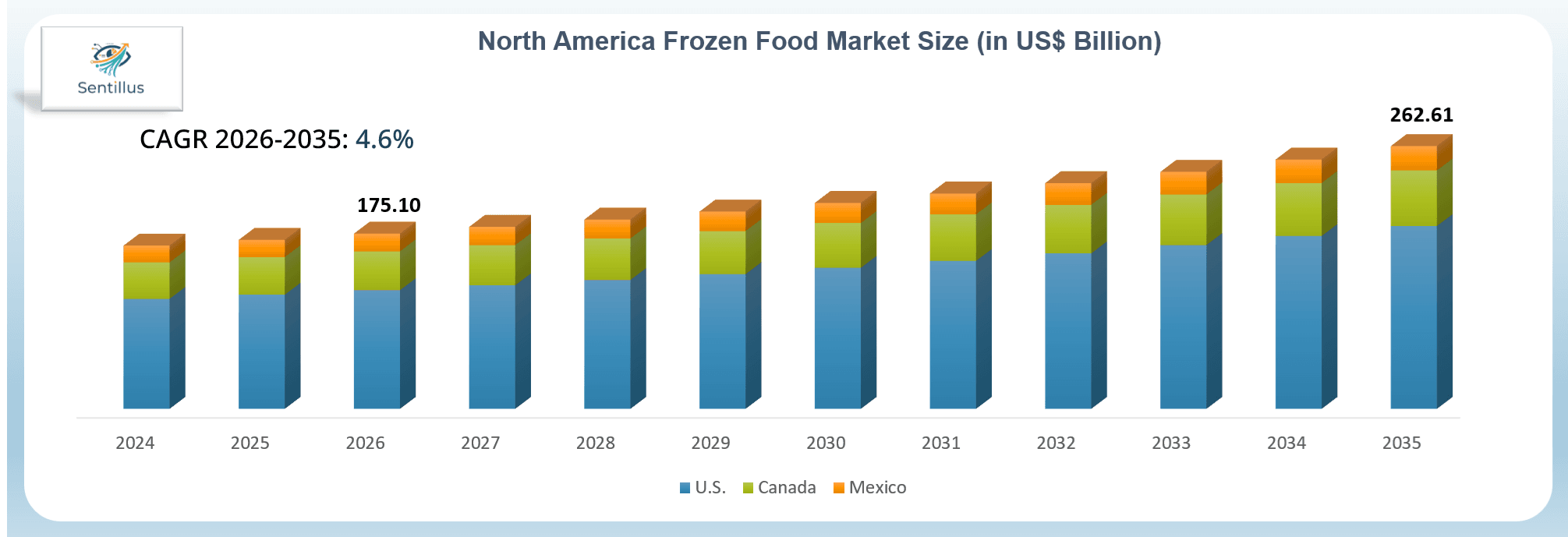
North America forms one of the best-developed frozen food markets in the world, where commercial demand is backed by a well-established food processing industry, instead of nascent sector. Product innovation, premiumization and improved logistics matters more than volume growth, enabling manufacturers to create value even with relatively slow growth rates. North America Frozen Food Market demand amounting to USD 175.10 billion in 2026 and is estimated to reach USD 262.61 billion by 2035, growing at a CAGR of 4.6%. B2B demand holds steady due to strong retail channel, while procurement by institutional customers also acts as a stable source of revenue due to long-term contracts with restaurants, hospitals, schools and caterers.
Manufacturing forms the backbone of regional competitiveness. Processing facilities located across the United States and Canada supply diversified frozen food portfolios covering vegetables, meat, seafood, bakery products, ready meals and desserts. Vertically integrated companies benefit from direct access to agricultural raw materials, modern freezing technologies and well-developed refrigerated transportation networks, reducing inventory losses while improving product availability throughout the year. Supermarkets continue serving as the dominant retail channel, although online grocery retailers have steadily increased frozen product penetration by expanding temperature-controlled last-mile delivery capabilities.
Commercial demand differs across the three major countries. The United States generated USD 118.55 billion in 2026 and remains the largest contributor because food manufacturing, cold-chain logistics and branded retail distribution operate on a national scale. Canada accounted for USD 38.76 billion, supported by high household freezer ownership and stable packaged food consumption. Mexico, with a market value of USD 17.79 billion, continues expanding through organized retail development, improving refrigerated logistics and increasing participation from multinational food manufacturers. Regional competition therefore reflects differences in market maturity rather than differences in consumer awareness, with product innovation driving mature markets while distribution expansion creates new opportunities in developing areas.
Market Dynamics
Driver: Foodservice Procurement Maintains Stable Frozen Food Demand Across North America
Restaurants, quick-service restaurant chains, hotels, hospitals and institutional catering companies purchase frozen products throughout the year to maintain standardized food quality while reducing preparation time and inventory losses. Procurement decisions increasingly prioritize supplier reliability, product consistency and uninterrupted availability, creating predictable purchasing cycles that benefit manufacturers with diversified production capacity and established refrigerated distribution networks. Long-term commercial supply agreements reduce demand volatility and support high manufacturing utilization rates, allowing processors to optimize production planning across multiple frozen food categories.
Opportunity: Premium Frozen Convenience Foods Create Higher-Value Revenue Opportunities Across Organized Retail
Consumer purchasing behavior increasingly favors products requiring minimal preparation without compromising taste or quality. Premium ready meals, frozen bakery products, healthier frozen snacks and restaurant-inspired meal solutions continue gaining shelf space across supermarkets and online grocery platforms. Retailers benefit from higher average basket values, while manufacturers gain opportunities to improve margins through product differentiation rather than price competition alone. Expansion of premium portfolios therefore presents a more sustainable commercial opportunity than increasing production of commodity-oriented frozen food categories.
Segment Analysis
By Distribution Channel: Supermarkets and Hypermarkets Retain Leadership Through Broad Product Assortment and Refrigerated Infrastructure
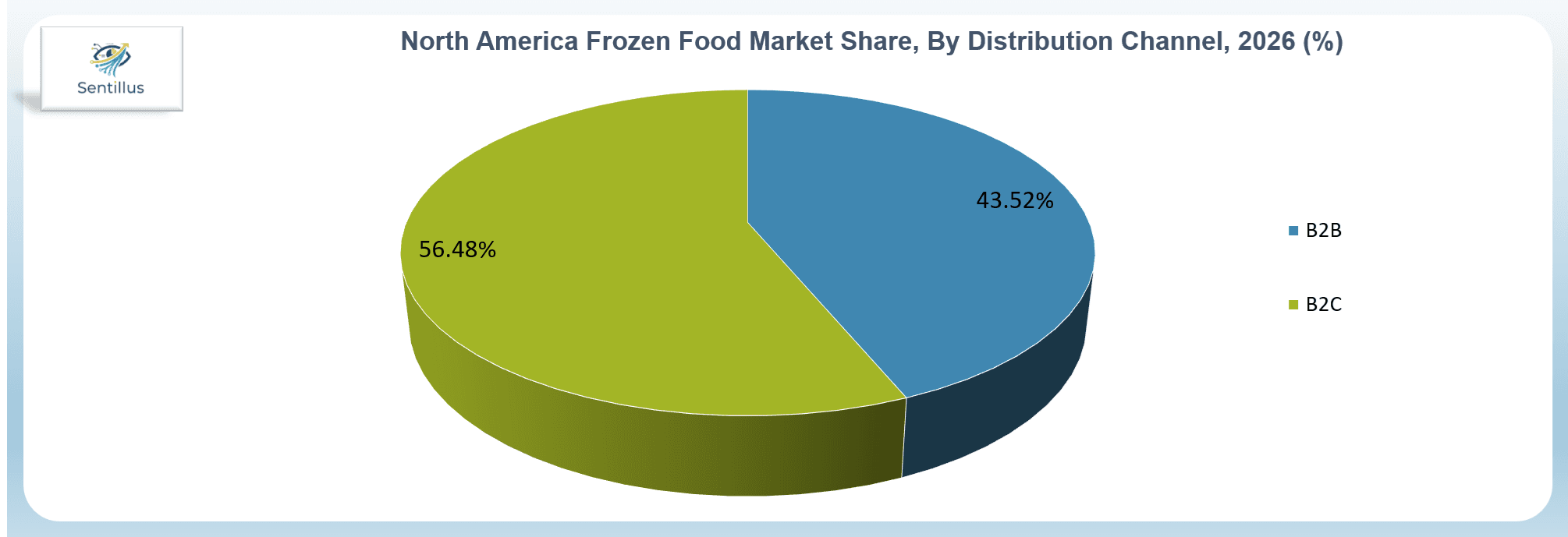
Large-format retail stores remain the principal sales channel across North America because they combine extensive freezer capacity with diversified product portfolios. Consumers increasingly purchase multiple frozen food categories during routine grocery shopping, allowing retailers to improve inventory turnover while expanding premium and private-label offerings. Strong relationships between retailers and multinational manufacturers also encourage continuous product launches, promotional campaigns and category expansion, reinforcing supermarket leadership despite rapid development of online grocery retail.
By Product: Frozen Bakery Products and Snacks Continue Generating Strong Commercial Value
Frozen bakery products and snacks maintain broad consumer acceptance because they combine convenience with frequent purchasing behavior. Breakfast products, pizzas, pastries, appetizers and snack foods achieve comparatively faster inventory turnover than several other frozen food categories, encouraging retailers to dedicate additional freezer space to these products. Manufacturers continue introducing premium recipes, clean-label ingredients and portion-controlled packaging to strengthen differentiation across mature consumer markets.
Regional Analysis
United States Frozen Food Market Landscape
The United States remains the commercial centre of the North American frozen food industry, generating USD 118.55 billion in 2026 and projected to reach USD 182.68 billion in 2035 at a CAGR of 4.9%. Large-scale food processors operate nationwide manufacturing and refrigerated distribution networks capable of supplying retail, foodservice and institutional customers with consistent product quality throughout the year. Consumption remains diversified across frozen ready meals, vegetables, poultry, seafood, desserts and bakery products, while organized retail continues introducing premium private-label offerings to strengthen category performance. Major manufacturers including Nestlé USA, Conagra Brands, Tyson Foods, Kraft Heinz, General Mills and McCain Foods maintain extensive production and distribution operations supporting both domestic demand and exports.
Canada Frozen Food Market Trends
Canada generated USD 38.76 billion in 2026 and is expected to reach USD 55.48 billion by 2035, reflecting a 4.1% CAGR. Household freezer ownership remains among the highest in North America, supporting consistent purchasing across frozen vegetables, seafood, ready meals and bakery products. National supermarket chains maintain broad frozen assortments, while domestic manufacturers continue investing in operational efficiency and product innovation to compete with multinational food companies. Geographic distance between production centres and population hubs also reinforces the importance of efficient refrigerated logistics throughout the country.
Mexico Frozen Food Market Analysis
Mexico accounted for USD 17.79 billion in 2026 and is forecast to reach USD 24.45 billion by 2035, expanding at a 3.6% CAGR. Organized retail expansion continues introducing frozen food categories to a broader consumer base beyond major metropolitan areas. International manufacturers increasingly view Mexico as both a growing consumer market and a regional manufacturing location because competitive labour costs and trade integration support efficient production and distribution across North America. Product demand remains strongest within frozen meat products, vegetables and convenience-oriented ready meals as household purchasing patterns continue evolving.
Competitive Landscape
Competition across the North American frozen food industry reflects the maturity of the regional food processing sector rather than aggressive capacity expansion. Most leading manufacturers compete through portfolio breadth, category specialization, distribution strength and retailer relationships instead of price-led strategies. Shelf space within supermarkets has become increasingly competitive as retailers continue expanding private-label frozen products while national brands defend market share through product innovation, premium positioning and category extensions. Foodservice remains another important battleground because long-term procurement contracts create predictable revenue streams and higher production utilization for manufacturers capable of meeting volume, quality and food safety requirements.
Regional competition can broadly be grouped into three commercial models. Diversified food manufacturers such as Nestlé, Conagra Brands, General Mills and The Kraft Heinz Company compete across multiple frozen food categories including ready meals, bakery products, snacks and desserts. Protein-focused companies including Tyson Foods leverage vertically integrated supply chains to strengthen their position within frozen meat and poultry products. Category specialists such as McCain Foods concentrate on frozen potato products while benefiting from integrated agricultural sourcing and dedicated processing facilities. Portfolio specialization has therefore become an effective strategy for maintaining pricing discipline without directly competing across every frozen food segment.
Manufacturing location increasingly influences competitive performance. Facilities positioned close to agricultural production areas reduce raw material transportation costs, while plants located near major consumption centres improve replenishment speed and lower refrigerated logistics expenses. Companies operating multiple production sites across North America are generally better positioned to respond to retailer demand fluctuations than businesses dependent on a limited manufacturing footprint. Distribution capability has consequently become almost as important as product innovation when competing for supermarket shelf space and institutional procurement contracts.
Key Competitive Strategies
| Company | Commercial Strategy |
| Nestlé USA | Broad frozen meal portfolio supported by strong retail distribution and continuous premium product development. |
| Conagra Brands | Portfolio diversification across frozen meals, snacks and value-added convenience products. |
| Tyson Foods | Vertical integration across poultry and prepared foods strengthens supply reliability and cost control. |
| McCain Foods | Category specialization in frozen potato products supported by integrated agricultural sourcing and processing. |
| General Mills | Expansion of convenience-oriented frozen offerings through established consumer brands. |
| Kraft Heinz | Brand recognition combined with selective participation across premium frozen food categories. |
Key Companies
BCG Matrix
| Quadrant | Companies | Commercial Position |
| Stars | McCain Foods, Nestlé USA | Strong category leadership supported by diversified manufacturing and broad regional distribution. |
| Cash Cows | Tyson Foods, Conagra Brands, General Mills | Established brands operating in mature product categories with stable commercial demand. |
| Question Marks | Kraft Heinz, Ajinomoto Foods North America | Opportunities remain through premium frozen meals and expanding convenience food portfolios. |
| Niche Specialists | Regional frozen bakery and specialty food manufacturers | Compete through product specialization, local distribution and category expertise rather than manufacturing scale. |
Regulatory Landscape
Food safety regulations shape product development, manufacturing practices and commercial distribution throughout North America. Frozen food manufacturers operating in the United States must comply with the Food Safety Modernization Act (FSMA) administered by the U.S. Food and Drug Administration (FDA), which requires preventive food safety controls, supplier verification and risk-based manufacturing practices. Product labeling, ingredient declaration and nutrition information are governed by 21 CFR Part 101, establishing standardized requirements for packaged frozen food sold through retail channels.
Canadian manufacturers operate under the Safe Food for Canadians Regulations (SFCR) administered by the Canadian Food Inspection Agency (CFIA). Regulatory requirements cover licensing, preventive control plans, traceability and food labeling, supporting consistent food safety standards for both domestic sales and exports. Compliance with internationally recognized food safety management systems such as HACCP, FSSC 22000 and BRCGS has become a commercial requirement for many retailers and institutional buyers rather than simply a regulatory expectation.
Mexico regulates frozen food manufacturing and commercialization through COFEPRIS together with national food labeling and sanitary regulations. Cross-border trade under the United States-Mexico-Canada Agreement (USMCA) facilitates movement of food products throughout North America while preserving regulatory oversight related to food safety, labeling and product quality. Companies supplying multiple North American markets therefore design manufacturing and quality systems that satisfy the most stringent regulatory requirements across the region.
Key Developments
| Month | Company | Development | Commercial Impact |
| February 2025 | McCain Foods | Expanded regenerative agriculture program through a new Farm of the Future initiative. | Strengthened long-term raw material availability and supply-chain resilience. |
| August 2025 | McCain Foods | Confirmed major investment in additional frozen potato processing capacity. | Improved manufacturing capability supporting long-term North American and export demand. |
| January 2026 | Conagra Brands | Expanded selected premium frozen meal offerings across North American retail channels. | Strengthened premium convenience food portfolio within mature retail markets. |
| March 2026 | Nestlé USA | Introduced new frozen meal variants targeting premium convenience food consumers. | Broadened product portfolio supporting higher-value retail categories. |
| June 2026 | Tyson Foods | Expanded prepared food capacity supporting foodservice customers. | Increased production flexibility for institutional procurement and restaurant supply. |
Future Outlook
Commercial expansion across North America is likely to depend more on portfolio value than production volume. Household penetration has already reached relatively high levels across major frozen food categories, limiting opportunities generated solely through new consumer adoption. Manufacturers are therefore expected to prioritize premium product development, healthier formulations, restaurant-inspired meals and differentiated packaging formats capable of generating higher average selling prices.
Institutional procurement will remain a stabilizing influence because restaurants, healthcare facilities, educational institutions and contract catering companies continue requiring standardized frozen ingredients throughout the year. Retail competition is expected to intensify as supermarkets expand private-label frozen portfolios while online grocery platforms improve refrigerated delivery capability. Distribution efficiency, localized manufacturing and integrated cold-chain management are therefore expected to influence competitive positioning as much as product innovation during the forecast period.
Who Should Buy This Report in 2026?
The Sentillus Frozen Food Market Report (2026 Edition) is designed for organizations involved in frozen food manufacturing, processing, distribution, retail, foodservice, cold-chain logistics, packaging and investment across global markets.
Frozen Food Manufacturers
Identify growth opportunities across ready meals, frozen snacks, vegetables, fruits, seafood, meat and bakery products while benchmarking competitors and evaluating evolving consumer demand trends.
Food Processing Companies
Assess opportunities for production expansion, ingredient innovation, automation adoption, value-added product development and manufacturing optimization supporting long-term business growth.
Retailers and Supermarket Chains
Understand purchasing trends, category performance, private-label opportunities, regional demand patterns and merchandising strategies influencing frozen food sales across organized retail channels.
Foodservice Operators and Quick-Service Restaurant Chains
Evaluate procurement strategies, menu innovation opportunities, convenience food demand, portion optimization and supply reliability supporting commercial kitchens and restaurant operations.
Cold-Chain Logistics and Warehousing Companies
Identify investment opportunities related to refrigerated transportation, frozen warehousing, distribution network expansion and temperature-controlled logistics supporting growing frozen food demand.
Packaging Manufacturers and Material Suppliers
Analyze future demand for sustainable packaging, flexible films, trays, cartons, vacuum packaging and advanced preservation technologies improving product quality and shelf life.
Ingredient Suppliers
Assess opportunities related to vegetables, fruits, seafood, meat, dairy, seasonings, preservatives and functional ingredients supporting innovation across frozen food product categories.
Government Agencies and Food Safety Authorities
Understand food safety regulations, labeling requirements, cold-chain standards, import-export policies and sustainability initiatives shaping the global frozen food industry.
Investors, Private Equity and Corporate Strategy Teams
Identify high-growth product categories, evaluate acquisition opportunities, benchmark competitive positioning and assess long-term investment potential across the expanding frozen food ecosystem.
Research Institutions and Product Development Teams
Support innovation in freezing technologies, shelf-life optimization, nutrition preservation, packaging advancements, consumer behavior analysis and next-generation food processing solutions driving future industry growth.
Frequently Asked Questions
Manufacturers should evaluate the product’s freezing behavior, ingredient stability, texture after thawing or reheating, packaging compatibility, target preparation method and expected storage period. Formulation decisions should also account for production scalability and the quality characteristics consumers expect after the product has been prepared.
Freezing conditions can influence ice-crystal formation, texture, moisture retention and the appearance of food after thawing or cooking. Freezing technology and processing parameters therefore need to be matched with the characteristics of the product rather than treated as a one-size-fits-all manufacturing process.
Different freezing technologies provide different combinations of freezing speed, product handling capability, energy requirements and suitability for specific product formats. Manufacturers need to evaluate the characteristics of the food, required throughput, production configuration and quality objectives when selecting a freezing system.
Consistency can be improved through standardized raw-material specifications, controlled processing parameters, automated production systems, appropriate freezing conditions and systematic quality monitoring. Consistent manufacturing is particularly important for branded and private-label products supplied across multiple retail or foodservice locations.
Capacity expansion requires assessment of processing equipment, freezing systems, storage capacity, utilities, raw-material availability, packaging operations and distribution requirements. Companies should also evaluate whether additional production capacity can be supported by reliable procurement and sufficient downstream demand before committing capital to a new facility or production line.
Inventory management requires coordination between production planning, freezer capacity, demand forecasting, order cycles and distribution schedules. Longer product usability can provide greater planning flexibility but excessive inventory can still create storage costs and working-capital pressure, making accurate demand planning important for category profitability.
Retailers should assess expected consumer demand, product differentiation, pricing, packaging, freezer-space requirements, supplier reliability, promotional potential and expected inventory turnover. Products that provide a clear reason for inclusion in the assortment can create stronger category value than simply adding additional SKUs with limited differentiation.
Commercial attractiveness can depend on a combination of consumer relevance, margin potential, sales velocity, shelf or freezer efficiency, supply reliability and differentiation. Products that can generate repeat purchases while fitting efficiently within existing frozen-category operations may offer stronger commercial potential.
Quality preservation depends on maintaining appropriate storage conditions, minimizing temperature fluctuations, using suitable packaging and controlling storage duration. Manufacturers can also use monitoring systems and disciplined inventory rotation to identify deviations before they materially affect product quality.
Ingredient composition can affect moisture migration, texture, oxidation, flavor retention and the product’s behavior during freezing and subsequent preparation. Formulation therefore needs to be designed alongside the intended freezing process and packaging system rather than developed independently.
The decision should consider expected shelf stability, distribution distance, storage requirements, product quality, processing complexity, consumer preparation behavior and total logistics economics. Frozen and chilled formats can serve different commercial objectives, so the appropriate choice depends on the product and target distribution model.
Differentiation can be built around formulation, preparation convenience, portion format, ingredient quality, cuisine positioning, nutritional attributes, premium presentation, packaging and brand positioning. Companies can also differentiate through specialized products designed for particular consumption occasions or customer groups.
Product format affects processing requirements, freezing behavior, packaging configuration, storage efficiency and preparation characteristics. Formats such as whole, sliced, diced, breaded, minced, filleted, patties and nuggets can therefore require different manufacturing and handling approaches even when they belong to the same broad product category.
Assessment should extend beyond finished-product demand to include raw materials, processing, freezing equipment, packaging, warehousing, distribution, technology and supporting services. Mapping the value chain can help identify where capacity constraints, technical requirements or changing procurement patterns may create opportunities for new entrants and established suppliers.
Investors should examine manufacturing efficiency, capacity utilization, raw-material access, product mix, customer concentration, distribution capabilities, freezer infrastructure, working-capital requirements and the strength of customer relationships. Assessment of expansion requirements and operational resilience is also important when evaluating the long-term economics of a frozen food business.
The report is relevant to frozen food manufacturers, food processors, retailers, foodservice companies, ingredient suppliers, packaging companies, cold-chain businesses, equipment providers, investors and corporate strategy teams evaluating opportunities across the frozen food value chain.
The report provides structured analysis of the frozen food industry across distribution channels, freezing technologies, packaging types, product formats, nature, convenience levels, consumer categories, product categories, applications and geographic markets. It also evaluates market dynamics, competitive developments, industry trends and strategic opportunities.
Yes. Sentillus can customize the study according to specific research requirements. Customization may include additional countries or regions, alternative segmentation, competitor benchmarking, product-specific analysis, customer or channel assessment and other parameters required for a particular business decision.
Yes. A sample can be requested to evaluate the report’s structure, segmentation, analytical approach and level of detail before purchase.
Yes. The report includes competitive landscape analysis, company profiles, strategic developments and competitive assessment of relevant industry participants. Additional company benchmarking can be incorporated when a customized scope is required.
Yes. Sentillus analysts can clarify the report methodology, market definitions, segmentation, competitive analysis and other analytical components included in the study. Analyst discussions can also support interpretation of findings against specific business requirements.
Why Choose Sentillus?
Decision-Oriented Research
Sentillus delivers research designed for business decisions rather than information collection. Every study combines industry expertise, strategic analysis and practical market intelligence supporting investment, expansion and competitive planning.
Reliable Primary and Secondary Validation
Research integrates interviews with industry participants including manufacturers/service providers, dealers/distributors/agents/3rd-party suppliers and customers/consumers, public company disclosures, government publications, trade associations, consortiums, paid databases and verified industrial databases to improve analytical reliability.
Consultant-Level Industry Analysis
Every report explains why market changes occur, how competitive dynamics evolve and which developments create future business opportunities rather than simply presenting historical information.
Customized Business Intelligence
Clients receive research tailored to strategic priorities including market entry assessment, competitive benchmarking, supplier evaluation, investment opportunity analysis, pricing assessment and technology landscape studies.
Practical Competitive Insights
Competitive evaluation extends beyond company profiles by examining manufacturing capabilities, expansion strategies, product positioning, innovation priorities and strategic partnerships influencing industry leadership.
Comprehensive Regional Coverage
Country-level analysis evaluates industrial development, manufacturing capacity, production & yield, infrastructure investment, regulatory changes, trade activity and demand outlook across major global markets.
Continuous Research Support
Consultant assistance helps clients interpret findings, clarify market developments and understand industry trends after report delivery, ensuring greater value throughout the decision-making process.
High-Quality Research Standards
Every report follows a structured research methodology emphasizing data accuracy, logical analysis, clear business communication and actionable recommendations suitable for executives, investors and strategy planning teams.